The 5-Room Dungeon Method, With a Battle Map for Every Room
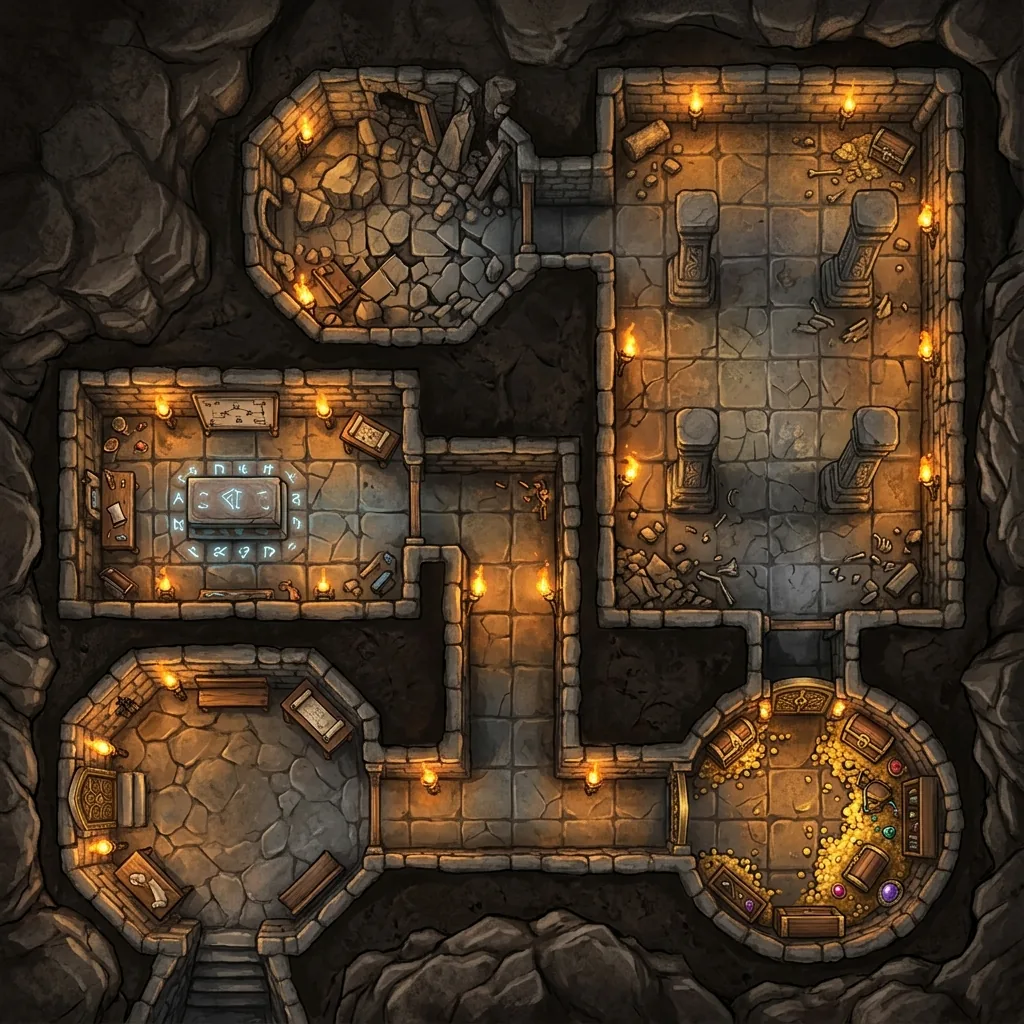
The 5-room dungeon is the single most reliable session-prep framework ever handed to Game Masters, and it was handed to us by Johnn Four of Roleplaying Tips. Through his long-running newsletter, Johnn has spent decades quietly making other people's games better, and this framework is his most enduring gift: five rooms, five dramatic beats, one complete adventure that fits inside a single session. It works for a literal dungeon, but the "rooms" can just as easily be the decks of a ship, the wings of a manor, or five clearings along a forest trail.
In this guide, we will walk through each of the five rooms, covering what the room does for pacing, how to design it well, and a copy-paste map prompt you can drop straight into a generator. We will then thread all five into a worked example, an abandoned shrine taken over by a cult, and finish with a look at how fast the method becomes when the maps take seconds instead of hours.
Why five rooms is the magic number
The framework endures because it is secretly a story structure wearing a dungeon costume. Room one hooks the party and establishes stakes. Room two changes gears and spotlights different characters. Room three twists the situation. Room four delivers the climax, and room five pays everything off while planting the next hook. That is a complete dramatic arc, small enough to prep in an evening and short enough to finish before anyone checks the clock. For a deeper look at pacing full-length crawls beyond five rooms, see our guide to designing the perfect dungeon crawl, and if you are sketching the floor plan on graph paper first, our reference table of dungeon map symbols covers the shorthand.
1. The entrance and the guardian
The first room answers the question every looted-out world raises: if this place holds treasure, why has nobody taken it? The guardian is the reason. This room sets the dungeon's tone, teaches the party its theme, and makes entry feel earned rather than free.
Design advice: the guardian does not have to be a monster. A collapsed stairwell, a warded door, or a suspicious gatekeeper all work, but if you do open with combat, keep it winnable and let the terrain introduce the dungeon's personality. A choke point at the entrance also gives cautious parties a tactical decision in the very first minute.
- The Prompt: "Top-down battle map of a ruined shrine entrance, cracked stone stairs descending into darkness, broken statue of a forgotten god, rubble choke point, tangled roots breaking through flagstones, flickering torchlight, gridless digital art."
2. The puzzle or roleplaying challenge
Room two deliberately changes the pace. After the guardian, the party gets a challenge that swords cannot solve: a riddle, a ritual, a negotiation with something that talks. This is where the quieter players at your table get their spotlight.
Design advice: build puzzles that fail forward. A wrong answer should cost resources or time, not halt the session. Anchor the puzzle in something physical on the map, such as sigils on the floor or statues that must be turned, so players can point at what they are manipulating.
- The Prompt: "Top-down battle map of a flooded ritual antechamber, circular mosaic floor with four carved sigils, shallow dark water, stone braziers on narrow ledges, vaulted alcoves, cool blue moonlit tones, gridless digital art."
3. The trick or setback
Room three is the twist. The bridge collapses behind the party, the treasure is a decoy, the prisoner they rescued is a spy. The setback raises the tension right before the climax and reminds players that the dungeon is smarter than it looks.
Design advice: the best setbacks change the party's plan rather than punishing them for having one. Blocking the way back, splitting the party briefly, or revealing that the real objective has moved all push the story forward. Keep this room mechanically light so it does not steal the climax's thunder.
- The Prompt: "Top-down battle map of a crumbling stone bridge over a black chasm, fallen pillars, loose broken planks, narrow side ledge, swirling mist rising from below, dramatic amber torchlight, gridless digital art."
4. The climax
Room four is the big battle, the confrontation the whole dungeon has been building toward. Every earlier room has spent tension into this one, so it deserves the largest space and the most interesting terrain in the complex.
Design advice: give the room tactical furniture. Elevation, hazards, cover, and an objective beyond "reduce enemies to zero" all make a climax memorable, so let the cult finish the ritual unless someone crosses the room to stop it. This is the map worth generating at higher resolution, because it is the one your players will stare at longest.
- The Prompt: "Top-down battle map of a grand cult sanctum, central sacrificial altar on a raised dais, glowing green ritual circle, rows of toppled pews, side alcoves with burning braziers, cracked marble floor, dramatic emerald light, gridless digital art."
5. The reward and the revelation
The final room pays the party for the whole excursion, but the lasting reward is information. Treasure gets spent; a revelation that recontextualizes the adventure and points at the next one keeps your campaign moving.
Design advice: hide the hook inside the loot. A ledger among the coins, a map carved into the vault wall, or a symbol matching one the party has seen before turns a payout into a plot. Small, intimate rooms work best here, a deliberate exhale after the climax.
- The Prompt: "Top-down battle map of a hidden reliquary vault, small stone chamber, open sarcophagus, scattered gold coins and ancient scrolls, a glowing map etched into the far wall, warm candlelight, gridless digital art."
A worked example: the shrine of the silent flame
Here is the framework threaded into one coherent mini-dungeon. An abandoned hillside shrine, once sacred to a fire goddess, has been claimed by a cult trying to relight the altar with something that is not fire.
The party descends the cracked entrance stairs and meets the guardian: a stitched-together temple guard the cult left to watch the door, fighting from behind the rubble choke point. Past it, the flooded antechamber holds the puzzle, four sigils that must be lit in the order told by the shrine's mural. In room three comes the setback: crossing the chasm bridge, the party sees cultists on the far side cut the support ropes, forcing a dangerous climb and announcing that the enemy knows they are coming. The sanctum delivers the climax, a ritual in progress on the dais with the green circle brightening each round. And in the reliquary behind the altar, the revelation: the cult already carried the true relic away, and the map etched into the vault wall shows exactly where they took it. Five rooms, five maps, one complete session, and next week's adventure already hooked. For a second worked example in a more familiar setting, our goblin cave guide breaks a classic starter lair into the same five beats.
From framework to table in one evening
The 5-room dungeon was always fast to write; the maps were the slow part. Hand-drawing five rooms or hunting through map packs for pieces that match a shrine, a chasm, and a sanctum could take longer than writing the adventure itself. Procedural tools generate layouts instantly but cannot aim for your specific scenes, a trade-off we explore in our comparison of Watabou and AI battle maps. With an AI dungeon map generator, each room above is one pasted prompt and a few seconds of waiting, and you can regenerate any area that does not match your vision before the session.
If you want more prompts to remix into your own five rooms, our library of 50 AI battle map prompts covers every environment from sewers to sky temples, and for room five specifically our boss arena battle map ideas gives ten climaxes with a hazard each. Then put Johnn Four's framework to work: sign up for the Text to Tabletop app today and start generating custom maps in seconds.
Tyler V
Lead Developer and UX Designer at Text to Tabletop. Passionate about helping GMs and players create better TTRPG experiences.
Ready to Forge Your Next Battle Map?
Describe the encounter and get a grid-aligned, top-down battle map in seconds, then regenerate any area until it matches your vision.
Generate Your First Map Free3 free map tokens · no credit card required