Draw Steel Battle Maps: Squares, Forced Movement, and Map Ideas
Draw Steel is a tactical roleplaying game that puts combat on a grid and keeps it there. Positions are tracked in squares, movement and abilities are described in squares, and a large share of the interesting effects in the game push, pull, slide, or teleport a creature to a square it did not choose. That design makes the battle map less of a visual aid and more of a working component, closer to the board in a skirmish game than to the atmospheric illustration a narrative system can get away with.
This guide covers what changes when you build maps for a system like this: sizing, the terrain that actually matters, and six prompts you can use tonight.
Does Draw Steel need a grid?
Yes. Draw Steel measures everything in squares, so a gridded playing surface is part of running it rather than an optional aid. You can play on a battle mat, on a virtual tabletop that draws its own grid, or on a printed map with a one inch grid. What you cannot easily do is run it theater of the mind, because forced movement, area effects, and positioning abilities all resolve in exact square counts.
What changes when the grid is mandatory
In a system where maps are optional, a plain room works fine, because the map is mostly there to help people picture the scene. When the grid is load bearing, a plain room is a bad encounter. Three things become non negotiable.
Every square needs a reason to exist. If a thirty by thirty map has interesting features only in the middle, the outer ring is dead space that players cross without making decisions. Tactical systems reward maps where the features are distributed, not centered.
Hazards and edges are content, not decoration. A system built around pushing and pulling creatures turns every cliff, pit, lava channel, spike pit, and open window into a payoff. A map with no edge to be shoved off is a map where a whole category of abilities does nothing.
Elevation and blocking terrain shape the whole fight. Pillars, low walls, crates, and raised platforms create the lanes that make positioning matter. Without them, both sides line up and trade, which is the failure mode of every tactical encounter ever run.
The upshot is that maps for a grid first system look more like arenas than like rooms. That is not a criticism. It is the genre.
Sizing a Draw Steel map
Tactical systems tend to have more mobility than average, and encounters tend to run with more combatants on the board, so the comfortable defaults skew slightly larger than a typical fantasy encounter.
A tight arena at around 20 x 20 squares suits a fight where the two sides are in contact on round one, which is often exactly what you want for a short, brutal scene. Around 30 x 30 squares is the workhorse, giving mobile characters somewhere to go and ranged characters lanes to work without creating a marathon. Around 40 x 30 is for set pieces: a bridge fight, a siege breach, a moving battle across a series of platforms.
Above that, watch your round count. A big map in a mobility heavy system can be brilliant, but only if the extra space is full of things to interact with. The full conversion table for squares, virtual tabletop pixels, and print inches is in our battle map size guide.
The five terrain features worth building around
Edges and drops. Cliffs, chasms, balconies, pier ends, open shaft mouths. These are what make forced movement lethal rather than cosmetic, and one good drop changes how the whole party plays the fight.
Hazard tiles. Lava channels, brazier coals, acid pools, spike beds, magical runes. Same function as a drop, but they can sit in the middle of the map where a cliff cannot.
Elevation bands. Two or three height levels connected by stairs, ramps, or ledges. Elevation gives melee characters a reason to climb and ranged characters a reason to hold, and it makes a shove downward as interesting as a shove sideways.
Blocking cover in a scattered pattern. Pillars are the ideal here: they create cover everywhere without creating a single wall that splits the map in two.
Chokepoints with an alternative. One narrow bridge is a puzzle. One narrow bridge plus a risky ledge route is an encounter, because now the party has a decision rather than a queue.
If you want a broader tour of terrain ideas that apply to any tactical system, our 10 battle map ideas piece is a good starting point, and the 50 prompts collection has ready made scenes.
Six map prompts for tactical encounters
Paste these straight into a generator. Each one is built around at least two of the five features above.
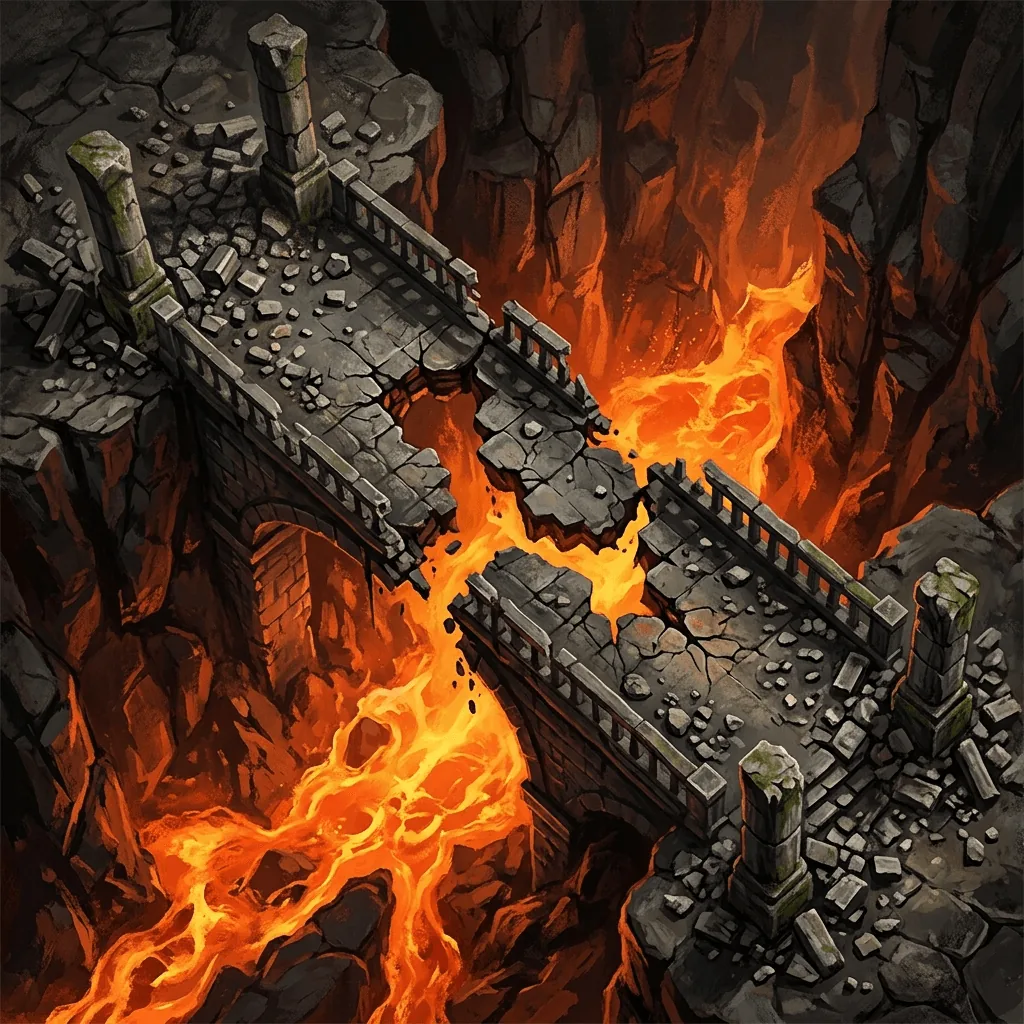
1. The shattered bridge. "Top-down battle map of a broken stone bridge spanning a deep lava chasm, three collapsed sections leaving narrow gaps, crumbling side railings, glowing molten rock far below, scattered rubble on both approaches, gridless digital art."
2. The foundry floor. "Top-down battle map of a dwarven foundry interior, channels of molten metal crossing the floor, raised iron walkways with railings, heavy machinery and anvil stations as cover, orange forge light and deep shadow, gridless digital art."
3. The terraced shrine. "Top-down battle map of a hillside shrine on four stone terraces connected by narrow staircases, weathered statues along each level, a central altar on the top terrace, a steep drop on one side, overcast daylight, gridless digital art."
4. The pillared cistern. "Top-down battle map of a vast underground cistern, rows of massive stone pillars rising from shallow dark water, raised dry walkways between them, a broken aqueduct spilling water at one end, dim green lit gloom, gridless digital art."
5. The storm deck. "Top-down battle map of a large sailing ship deck in a storm, wet planking, cargo crates and coiled rope as cover, a raised quarterdeck with stairs on both sides, open hatch to the hold, dark churning sea visible past the rails, gridless digital art."
6. The collapsing library. "Top-down battle map of a ruined library hall, toppled and standing bookshelves forming a maze of lanes, a caved in section of floor opening onto the level below, an upper gallery walkway around all four walls, dusty shafts of light, gridless digital art."
Each of those has a drop or a hazard, blocking cover, and at least one route choice. That is the whole recipe. Our prompt formula guide explains why naming the cover and the light does most of the work.
Gridless art, gridded play
One small but important note for a grid first system: you still want the map file itself to be gridless. Virtual tabletops draw their own grid and measure on it, so a grid painted into the image just competes with the real one. Keep the art clean and let the software or your printer supply the lines. Our breakdown of gridded and gridless maps covers the details, including how to add a grid when you print.
Text to Tabletop generates at a strict ninety degree top down angle with no baked in grid, which is exactly the shape a tactical system wants: squares that line up with your virtual tabletop on the first import, and terrain you asked for by name. Sign up for the Text to Tabletop app, use your 3 free tokens, and build the arena your next fight deserves.
Tyler V
Lead Developer and UX Designer at Text to Tabletop. Passionate about helping GMs and players create better TTRPG experiences.
Ready to Forge Your Next Battle Map?
Describe the encounter and get a grid-aligned, top-down battle map in seconds, then regenerate any area until it matches your vision.
Generate Your First Map Free3 free map tokens · no credit card required