Watabou's One Page Dungeon vs AI Battle Maps: Procedural vs Generative
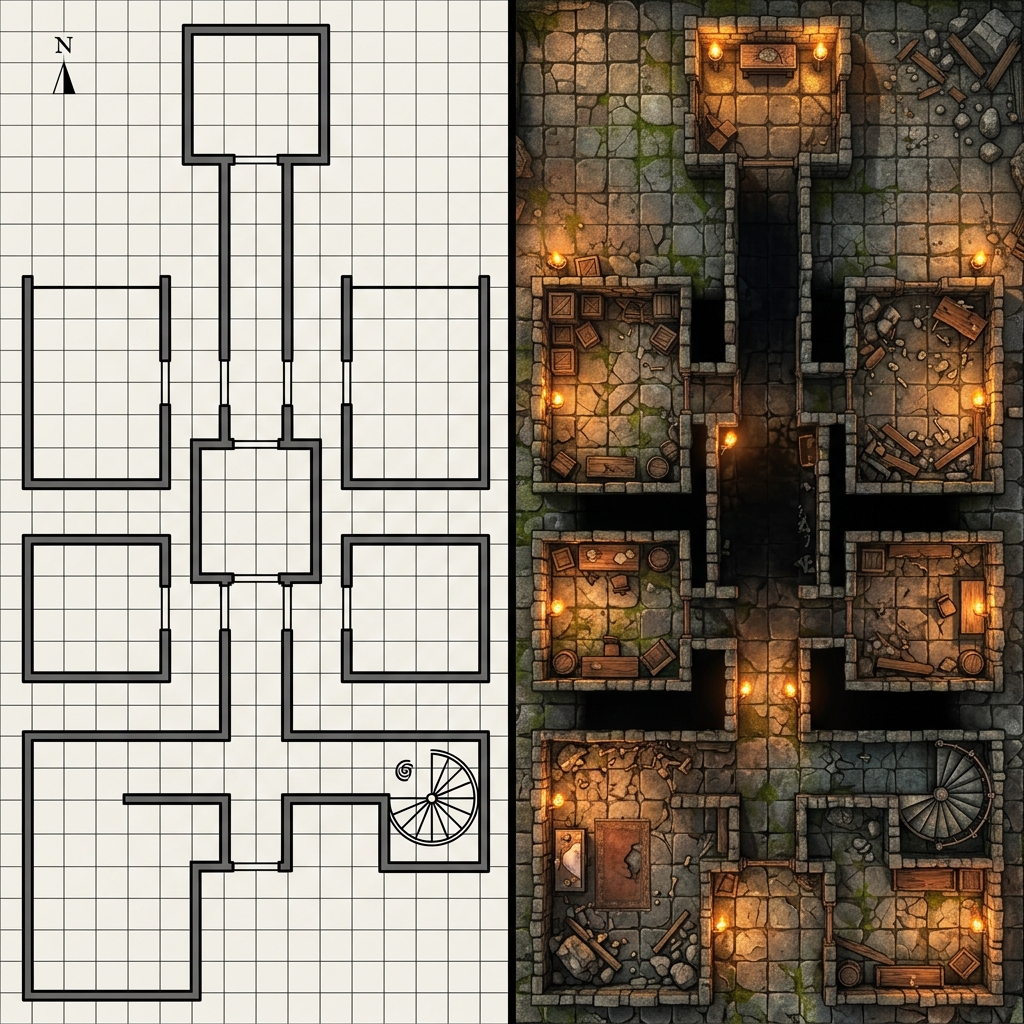
Every Game Master has been there. It is an hour before the session, your players have decided to veer off into a ruin you never intended for them to explore, and you need a layout immediately. For years, the gold standard for this exact moment has been Watabou’s One Page Dungeon, a tool that is rightfully beloved for its speed and its minimalist charm. However, as the landscape of tabletop RPG prep changes, many GMs are looking for a Watabou alternative that offers more visual depth and atmospheric immersion without sacrificing that essential speed.
What Is Watabou's One Page Dungeon Generator?
To understand why this tool is such a staple in the TTRPG community, you first have to appreciate its simplicity. Watabou’s One Page Dungeon is a procedural dungeon generator that focuses almost entirely on layout and logic. When you click that "randomize" button, the tool uses an algorithm to determine where rooms should go, how they connect, and what might be inside them based on classic dungeon-crawling tropes.
The output is usually an SVG file or a PNG that looks like a hand-drawn map from an Old School Essentials or Mörk Borg module. It gives you clean lines, simple cross-hatching for walls, and clear labels. It does not try to be a piece of high-fantasy art. Instead, it provides a blueprint. For a GM who thrives on improvisation, this is often enough. It tells you that Room 4 contains a "Mechanical Trap" and a "Slight Smell of Ozone," and you take it from there. Because it is procedural, it follows a set of hard-coded rules to ensure that every dungeon is technically "playable" with logical paths and loops.
What Is AI Battle Map Generation?
In contrast, generative AI represents a shift from rules-based logic to pixel-accurate artistry. When you use an AI dungeon map generator, you are not just getting a blueprint; you are getting the entire atmosphere of the room. You aren't just looking at a square labeled "Crypt." You are looking at the weathered stone of the sarcophagi, the flickering light of magical lanterns, and the moss creeping through the floor tiles.
Text to Tabletop takes this a step further by solving the common headaches of generic AI image generators. While a standard AI might give you a beautiful "artistic" view from a weird angle, our tool uses an automatic 90-degree top-down lock. This ensures the result is a functional battle map rather than a concept painting. Furthermore, it automatically strips away unwanted elements like baked-in grids or confusing NPC figures that you didn't ask for. This results in a clean, immersive environment that is ready for your virtual tabletop or physical printout immediately. It is prompt-driven, meaning you have granular control over the aesthetic, whether you need a neon-soaked cyberpunk laboratory or a gritty, blood-stained ritual chamber.
Procedural vs Generative: What's the Difference?
The debate between these two methods often comes down to the "Rules vs. Dreams" paradigm. Procedural generation, like what you find in Watabou’s tools, relies on a "seed" and a set of instructions. Think of it like a very complex flowchart. The developer has told the computer: "If you place a large room, follow it with two small rooms or a hallway." This makes the output predictable in structure, which is great for game balance, but limited in visual variety.
Generative AI works through neural networks that have "learned" what a dungeon looks like by analyzing thousands of images. It does not follow a flowchart; it predicts what pixels should be next to each other to create the image you described. This is why AI can create textures, lighting, and specific themes that procedural generators simply cannot reach. While procedural generation builds the skeleton, generative AI builds the skin, the lighting, and the mood.
When Watabou Wins
There are absolutely times when a procedural tool is the superior choice for your table. If you are running an OSR-style game where the "map as a puzzle" is the primary focus, Watabou’s minimalist style is perfect. It does not distract the players with beautiful art; it keeps them focused on the geometry of the space.
Watabou is also the king of the "Zero Budget" prep. It is a free tool maintained by a developer who clearly loves the hobby, and it requires zero learning curve. If you literally only need a quick idea for a layout to sketch onto a dry-erase mat, there is no reason to look further. It provides instant layout inspiration that you can interpret however you like. It is the digital equivalent of a random encounter table for architecture.
When AI Battle Maps Win
You should consider an AI-powered Watabou alternative when immersion is your top priority. If your players struggle to engage with "the theater of the mind" when looking at a black-and-white line drawing, a generative battle map can bridge that gap.
AI wins when you need:
- Atmospheric Immersion: You want the players to feel the chill of the ice cave or the heat of the forge through the visual details on the screen.
- Consistent Art Style: You can use specific prompts to ensure every map in your campaign looks like it belongs in the same world, something procedural generators struggle to do as they often have one fixed "look."
- Specific Narrative Details: If your villain's lair is specifically a "clockwork library filled with purple mist," a procedural generator will just give you a "library." An AI generator will give you the gears and the mist.
Because Text to Tabletop handles the technical aspects like the top-down perspective and grid removal, you get the beauty of high-end concept art with the utility of a traditional battle map.
The Workflow Hack: Use Both
You do not actually have to choose one over the other. In fact, many of the most efficient Game Masters use a "Hybrid Workflow" to prep their sessions in record time.
Start by opening Watabou’s One Page Dungeon to generate a layout. Look at the shapes, the room connections, and the labels. This gives you the logical "bones" of your dungeon. Once you find a layout that fits your encounter, take the description of a specific room-for example, "An overgrown throne room with a collapsed ceiling"-and head over to our AI battle map app.
By describing the procedural layout to the AI, you get the best of both worlds: a logically sound dungeon structure and breathtaking, high-fidelity art for the actual combat encounters. You use the procedural tool for the "macro" planning and the AI tool for the "micro" immersion. This workflow ensures that your dungeon makes sense geographically while looking like a professional module when the tokens hit the table.
Choosing Your Best Tool
Whether you stick with the classic procedural charm of Watabou or move toward the high-fidelity future of generative AI depends on what your players value most. If they love the "blueprints and graph paper" feel of the 1980s, Watabou is a masterpiece. But if they are looking for a modern, cinematic experience where the map itself tells a story, it might be time to see what generative tools can do for your prep.
If you are ready to move beyond simple lines and boxes, you can start generating immersive battle maps at Text to Tabletop today. We are helping GMs create specific, grid-free, top-down environments that turn a standard encounter into a memorable set piece. Stop settling for generic layouts and start building the exact world your players deserve.
Tyler V
Lead Developer and UX Designer at Text to Tabletop. Passionate about helping GMs and players create better TTRPG experiences.
Ready to Forge Your Next Battle Map?
Describe the encounter and get a grid-aligned, top-down battle map in seconds, then regenerate any area until it matches your vision.
Generate Your First Map Free3 free map tokens · no credit card required