Is AI Art OK for Tabletop RPG Maps? An Honest Answer
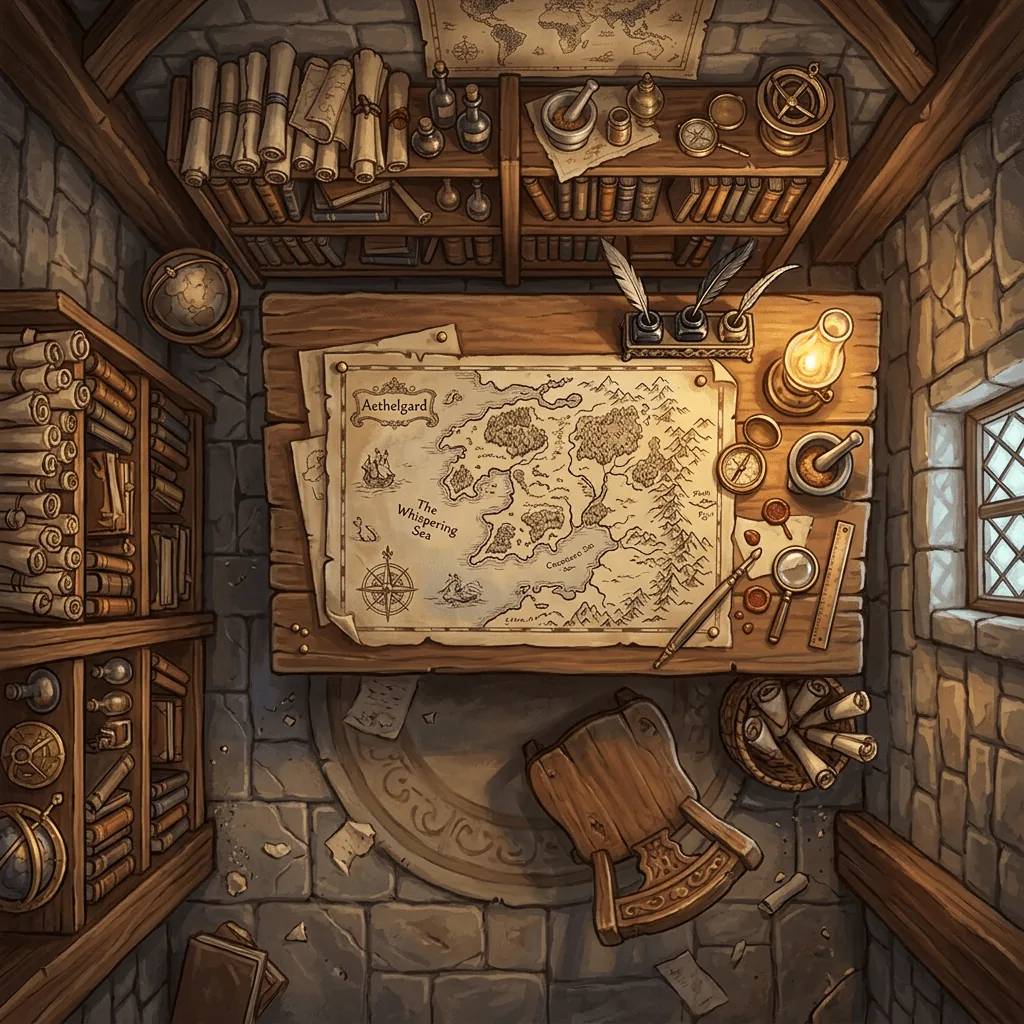
This question comes up in every thread about generated maps, and it deserves a straight answer rather than either of the two standard non answers. It is not "who cares, it is just a home game" and it is not "AI is theft, end of discussion." The honest position is that context decides it, and the contexts differ from each other much more than people expect.
We make an AI map generator, so read this knowing where we sit. We have tried to write the version we would want to read if we did not.
The short answer
For a private home game, using AI generated maps is broadly accepted and carries no rules problem: you are making a prop for your own table, and nobody's policy covers your Tuesday night. For anything you publish, sell, or post to a community, the answer depends on the specific storefront or forum, and several of the biggest ones restrict AI content, require disclosure, or ban it outright. The dividing line is not the technology. It is whether other people receive the work.
The three contexts, in order of looseness
1. Your own table
This is the clearest case. A map you generate for Thursday's session sits in the same category as a map you sketched on graph paper, a map you printed from a free library, or a map you bought. You are not distributing it, nobody is paying for it, and no publisher's terms apply to your living room.
The one genuine consideration here is your own players. A few people feel strongly about generative tools, and finding out mid session is a worse conversation than mentioning it beforehand. "I have been making our maps with an AI generator" takes four seconds and settles it.
2. Community spaces
This is where most people actually run into a rule, and it surprises them. Map and tabletop communities have spent the last few years writing policies, and they vary widely. Some subreddits and Discord servers ban AI generated art entirely. Some allow it with a required flair or tag. Some allow it only in specific threads. A few have no rule at all.
There is no shortcut here and no general principle that will save you: read the rules of the specific community before you post. The rules are usually in the sidebar and they usually say exactly what they mean. Posting an AI map to a community that bans them gets it removed and earns you a reputation you do not want, and the annoyance is entirely avoidable.
3. Publishing and selling
This is the strict end, and it is strict in ways that are easy to miss.
Major publishers in this space have taken public positions against using generative AI art in their own products and in work commissioned from creators. Storefronts for third party content have added disclosure requirements, and crowdfunding platforms have added AI disclosure fields to their project forms. Individual marketplaces set their own terms about whether AI assisted assets can be sold at all.
All of that changes over time, which is the main reason this section is short on specifics. If you are publishing, the only reliable step is to read the current terms of the exact platform you are publishing on, on the day you publish. A summary from a blog post, including this one, is not a substitute.
The second consideration is legal rather than editorial. In several jurisdictions, purely machine generated images have uncertain copyright status, which matters if your business depends on owning the asset. If you are selling an adventure and the maps are a selling point, that uncertainty is a real commercial risk in a way it simply is not for your home campaign.
The table
| Use | Generally accepted? | What to check |
|---|---|---|
| Maps for your own private game | Yes | Whether your own players care |
| Sharing a map with your group | Yes | Nothing |
| Posting to a map or RPG community | Depends | That community's posted rules |
| Free adventure shared publicly | Depends | Host platform terms, disclose anyway |
| Paid adventure or map pack | Often restricted | Storefront terms, disclosure rules, copyright status |
| Work commissioned by a publisher | Usually not permitted | The publisher's contract and stated policy |
| Crowdfunded project | Disclosure usually required | The platform's AI disclosure fields |
The ethical argument, stated fairly
The objection is not mainly about quality, and treating it as if it were is how these conversations go wrong.
The substantive version goes like this: image models were trained on enormous quantities of existing art, including the work of the same fantasy cartographers whose maps this hobby runs on, generally without permission or payment. Those cartographers make their living selling map packs and subscriptions. A tool that learned from their work and now produces work that competes with it has taken something real from them, whatever the legal analysis eventually says.
That is a coherent argument and it is not answered by pointing out that the output looks fine. The most common counterarguments are also worth stating honestly: that the majority of Game Masters using generated maps were never going to commission a custom map of their specific room at any price, so the displaced sale is often hypothetical; that hobbyists have always made their own props out of whatever was to hand; and that many working artists now use these tools themselves as part of a pipeline.
Where you land on that is a values question and this post is not going to resolve it for you. What we can say is that the strength of the objection scales with commerce. Generating a map of your campaign's bandit camp on a Tuesday is a very different act from selling a hundred page book of generated maps, and people who treat those as the same thing are not being helpful in either direction.
Our own position
We build a generator for home prep, and that is the use we think is clearly defensible. The product is aimed at the Game Master who needs a map of a specific room by Thursday, which is a need that the existing market was never going to serve, because nobody is going to draw a bespoke map of your flooded mill for a table of five people.
We also think the honest thing to say is that for published work, hiring a cartographer is still the right call. Human made maps carry a level of intention and consistency that matters a great deal across a whole book, and paying for that is how the people who invented this craft keep doing it. If you are making something to sell, budget for an artist.
Practical guidance if you use them
- At home, use them freely. Tell your players once.
- In communities, read the sidebar first. Every time, because the rules change.
- If you share, disclose. It costs nothing, it forecloses the argument, and people mind far less when you say so up front.
- If you sell, get human art. And if you must use generated assets, check the storefront's current terms and disclose them.
- Keep your prompts. They are the closest thing to documentation of what you made and how.
Where this leaves the tool
The reason generated maps caught on is not that they are cheaper than commissioning art. It is that they answer a question the market never did: what does the exact room I wrote look like, and can I have it before Thursday. Our guide on how to make AI battle maps covers the workflow, and our honest test of ChatGPT covers what general purpose models can and cannot do with top down tactical art.
If you would like to see how the alternative side of this looks, our comparison with Czepeku's hand crafted map packs is deliberately fair to the studio, because for a lot of tables a subscription to a great cartographer is the better answer.
And if your use is the home game one, that is the use we built for. Sign up for the Text to Tabletop app, use your 3 free tokens, and make the map your Thursday needs.
Tyler V
Lead Developer and UX Designer at Text to Tabletop. Passionate about helping GMs and players create better TTRPG experiences.
Ready to Forge Your Next Battle Map?
Describe the encounter and get a grid-aligned, top-down battle map in seconds, then regenerate any area until it matches your vision.
Generate Your First Map Free3 free map tokens · no credit card required