Midjourney Battle Map Prompts That Work (and Where They Break)
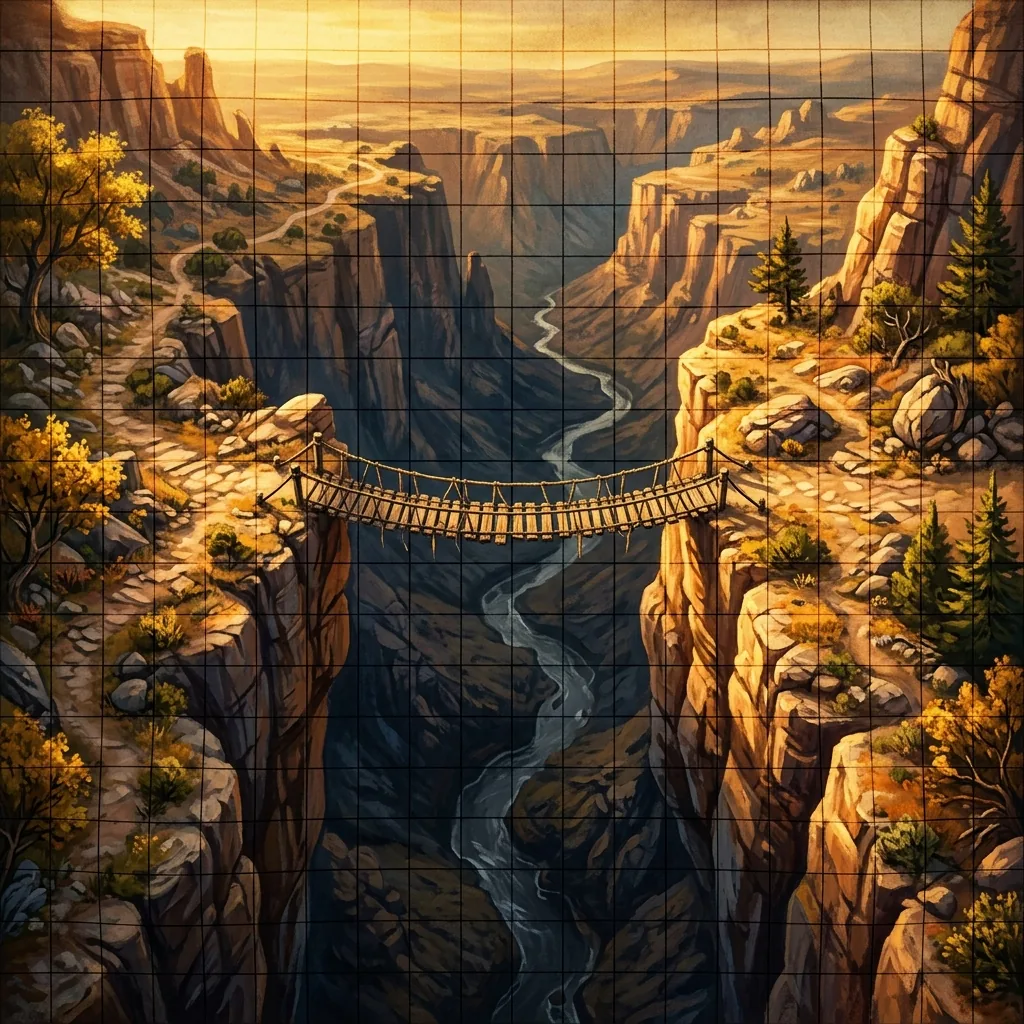
If you have been experimenting with Midjourney battle maps for your tabletop game, you have probably lived through the same cycle every Game Master does: a breathtaking first image, followed by an hour of rerolls trying to make it usable at the table. Midjourney is one of the most powerful art generators available, and it can absolutely produce gorgeous map-like images. The catch is that it was trained to make cinematic art, and a battle map is not cinematic art. It is a functional game asset with strict requirements: a true overhead view, consistent scale, and no baked-in clutter competing with your miniatures.
In this guide, we will share the Midjourney D&D map prompts that genuinely work, including the floor-plan trick that finally convinces the engine to render interiors from directly overhead. Then we will be honest about where those prompts break down, so you know exactly what you are getting before you commit to a subscription.
Why Midjourney fights the top-down view
Midjourney's training leans heavily toward dramatic compositions: eye-level portraits, sweeping three-quarter landscapes, concept art with depth and atmosphere. When you type "a dungeon battle map," the model reaches for the most artistic interpretation it knows, which is usually a moody corridor receding into darkness or an isometric diorama. Exteriors are relatively forgiving, because aerial photography of forests and rivers exists in abundance. Interiors are where it truly struggles. Ask for the inside of a tavern and the camera tilts, the walls gain height, and you end up with a beautiful painting of a room rather than a playable layout of one.
The fix is reframing. Midjourney has seen enormous numbers of architectural drawings, and those are reliably orthographic. When you describe an interior as a "floor plan" or a "top-down blueprint" instead of a "map," you tap into that architectural training and the camera finally locks down. This single vocabulary swap is the difference between fighting the tool and working with it.
The formula behind every prompt below
Each working prompt stacks the same elements in the same order: a floor-plan or top-down framing, the subject, concrete materials and features, lighting, and an art style, followed by the negative instructions "no text, no grid." The negative half matters as much as the descriptive half. Left to its own devices, Midjourney loves to decorate maps with compass roses, garbled labels, and ornamental grid lines, none of which you want baked into a play surface. The anatomy is the same one we teach in our guide to writing the perfect AI map prompt; Midjourney simply needs the structural half stated far more forcefully than a dedicated map tool does.
One more lever worth pulling: for wide encounter areas such as canyons, rivers, and streets, use Midjourney's aspect-ratio parameter (for example, --ar 16:9) so the canvas matches the shape of the fight instead of cropping it into a square.
Seven Midjourney battle map prompts that work
Every prompt below is ready to paste. Keep the framing words at the front and the negatives at the end, and change only the scene description in the middle. If you need more scene ideas, nearly any entry in our collection of 50 AI battle map prompts converts cleanly once you add this framing.
1. The ruined chapel (the floor-plan trick)
Interiors are Midjourney's weakest area, so this one leads with the architectural framing that tames them.
- The Prompt: "Top-down floor plan of a ruined stone chapel, collapsed roof open to the sky, broken wooden pews, moss creeping across cracked flagstones, a shattered altar, soft overcast light, orthographic top-down view, no text, no grid, painterly digital art."
2. The forest ambush clearing
Exteriors are the easiest win, and a clearing with cover lanes gives you an instant tactical fight.
- The Prompt: "Top-down orthographic view of a forest ambush clearing, a game trail cutting between mossy boulders, a fallen log barricade, dense pine canopy at the edges, late afternoon light with long shadows, no text, no grid, detailed digital art."
3. The dungeon crossroads (the blueprint variant)
When "floor plan" still drifts, "blueprint" pulls even harder toward a flat schematic look.
- The Prompt: "Top-down blueprint of a dungeon crossroads, four stone corridors meeting at an octagonal chamber, a rubble choke point, an iron portcullis, torch sconces casting warm pools of light, orthographic view, no text, no grid, dark fantasy digital art."
4. The canyon rope bridge
A wide scene that rewards the aspect-ratio parameter; run it with --ar 16:9 so the gorge stretches across the battlefield.
- The Prompt: "Top-down battle map of a desert canyon with a rope bridge spanning a deep gorge, narrow cliff ledges along both rims, scattered boulders, dramatic golden hour lighting with deep canyon shadows, orthographic top-down view, no text, no grid, painterly digital art."
5. The tavern floor plan
Add "no people" here. Midjourney loves to seat painted-on patrons at every table, and static NPCs confuse players mid-combat.
- The Prompt: "Top-down floor plan of a fantasy tavern interior, a long central hearth, scattered round tables and benches, a bar along one wall, a back storeroom, warm candlelight, architectural top-down view, no text, no grid, no people, detailed digital art."
6. The volcanic cavern
Caves read well from above because the lava provides its own lighting logic.
- The Prompt: "Top-down orthographic map of a volcanic cavern, branching lava channels, basalt columns, obsidian outcrops, glowing orange fissures lighting the cave floor from below, no text, no grid, high contrast digital art."
7. The coastal watchtower
A mixed interior and exterior scene, which is exactly where the floor-plan framing earns its keep.
- The Prompt: "Top-down floor plan of a ruined coastal watchtower on a rocky headland, a circular tower base with a collapsed wall, a wooden dock below the cliffs, crashing surf, cold storm light, orthographic top-down view, no text, no grid, moody painterly digital art."
Where these prompts break
Now for the honest half. Even with perfect prompting, Midjourney has a set of recurring quirks that matter specifically for battle maps.
Water arrives uninvited. Midjourney has a genuine fondness for ponds, streams, and flooding. Prompt a dry desert ruin and there is a real chance a scenic river appears through the middle of it. If your encounter design depends on dry ground, expect to reroll.
Interiors drift. The floor-plan trick works most of the time, not all of the time. A common failure mode is a flat floor with furniture rendered at a slight angle, or walls that lean outward as if the building were gently exploding. It looks fine as art and wrong the moment you place a miniature.
Grids come out decorative, not functional. If you ask for a grid, you get one, but the lines wander, warp around objects, and drift out of square. A warped grid can never align with a virtual tabletop's overlay, so the practical answer is to generate gridless and add the grid in your VTT. That works, but it means the grid keyword most GMs instinctively reach for actively hurts the result.
You cannot fix one area. This is the big one. If the tavern is perfect except for a smeared fireplace, Midjourney's variation tools reroll the character of the whole image. There is no way to regenerate just the fireplace, so a map that is ninety percent right often has to be abandoned entirely.
Print scale falls short. Standard output resolution is fine on a screen but runs out of pixels for large-format printing at the one-inch-per-five-feet scale physical tables need. A poster-sized dungeon printed from a default generation will look soft.
The subscription math only works at volume. Midjourney charges monthly whether you generate two maps or two hundred. If you are producing art constantly, that is fair value. If you need three maps a month for your campaign, you are paying for capacity you never use.
These failure points are not unique to Midjourney; general-purpose image tools share most of them, as we found when we tested whether ChatGPT can make battle maps.
A fair verdict
Midjourney is a phenomenal art tool, and nothing in this guide changes that. If you would rather run a model on your own hardware and trade money for control, our Stable Diffusion battle map prompts cover the same ground with negative prompts and ControlNet. Its texture, lighting, and composition are best in class, and with the prompts above it will hand you genuinely beautiful map-like images. If you want a stunning establishing shot of a region or a painterly backdrop for a theater-of-the-mind scene, it is a superb choice.
A dedicated AI battle map generator earns its place by adding the tactical guarantees on top: a strict 90-degree top-down lock you never have to prompt for, clean gridless output ready for your VTT's own grid overlay, area regeneration so you can fix the fireplace without losing the tavern, a .dd2vtt export that carries grid alignment straight into Foundry, and pay-per-map tokens instead of a monthly commitment. The two philosophies are not enemies; they are different tools for different jobs.
If you would rather spend your prep time designing encounters than negotiating with a camera, sign up for the Text to Tabletop app today, use your 3 free tokens, and start generating table-ready battle maps in seconds.
Tyler V
Lead Developer and UX Designer at Text to Tabletop. Passionate about helping GMs and players create better TTRPG experiences.
Ready to Forge Your Next Battle Map?
Describe the encounter and get a grid-aligned, top-down battle map in seconds — then regenerate any area until it matches your vision.
Generate Your First Map Free3 free map tokens · no credit card required