Dungeon Scrawl vs AI Battle Maps: Line Art or Full Rendering?
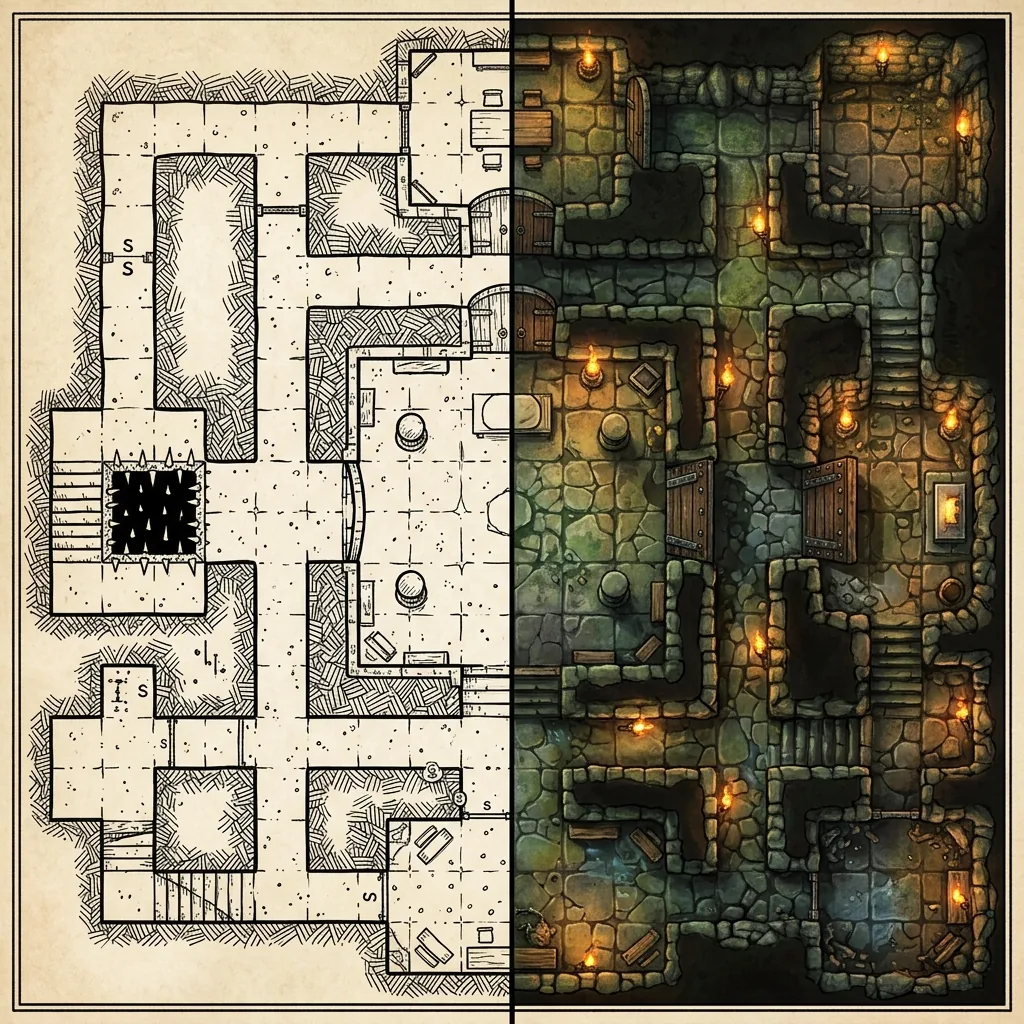
Dungeon Scrawl occupies a rare spot in the tabletop RPG toolbox: it is free, it runs in your browser, and it produces clean, old-school line-art dungeons faster than almost anything else on the internet. If you are weighing Dungeon Scrawl against an AI battle map generator, you are really choosing between two philosophies of what a map is for. One gives you a crisp architectural drawing that prioritizes geometry and clarity. The other gives you a painted scene that prioritizes texture and mood. Both are valid answers, and they are answers to different questions.
In this comparison, we will look honestly at where Dungeon Scrawl genuinely wins, where AI-generated battle maps win, and why the smartest workflow for many Game Masters quietly uses both. We have run this exercise before with procedural tools, and if you enjoyed our Watabou comparison, this one follows the same honest playbook: real strengths first, trade-offs second, verdict last.
What Dungeon Scrawl is
Dungeon Scrawl is a free, browser-based dungeon mapper with a classic line-art aesthetic, the kind of crisp black-and-white floor plan you would find in an old-school adventure module. You draw rooms and corridors, and the tool handles the walls, hatching, and shadows so the result looks hand-inked rather than diagrammed. It is owned by Roll20, and that relationship shows in the best way: the tool received a major interface overhaul in 2025, and it now offers near-real-time syncing of maps straight into Roll20 games. In May 2026, Roll20 shipped a random dungeon generator built on Dungeon Scrawl, marketed pointedly as using no AI, which can hand you a complete geometric layout in one click.
What Dungeon Scrawl deliberately does not do is render. There are no painted textures, no lighting, no moss creeping across flagstones. It excels at fast geometric dungeon layouts and makes no attempt at atmospheric scenes, and that focus is a feature, not an oversight.
Where Dungeon Scrawl genuinely wins
The first win is speed to a classic layout. If your goal is a readable dungeon floor plan, Dungeon Scrawl gets you there in minutes, and the new random generator gets you there in seconds. The second is price: it costs nothing, requires no install, and runs on whatever machine you happen to be sitting at. For a Game Master on a zero budget, that combination is unbeatable.
The third win is aesthetic fit. For OSR tables running Old School Essentials, Mörk Borg, or similar systems, the austere line-art look is not a compromise; it is the point. A stark floor plan keeps players focused on the geometry of the space, the mapping, and the puzzle of the dungeon itself, and it leans on the same classic notation our guide to dungeon map symbols catalogues. The fourth win is the Roll20 tie-in: if Roll20 is your virtual tabletop, having your map edits sync into your game near-real-time removes an entire export-import step from prep. And the fifth is total layout control. Every wall, door, and corridor sits exactly where you put it, which matters enormously when the dungeon's precise shape is part of the challenge.
Where AI battle maps win
AI generation wins the moment you want the map to carry atmosphere instead of just information. A painted, textured scene, with torchlight pooling on wet stone, rot in the corners, and weather on the battlements, does storytelling work that line art simply cannot. Even grimdark tables that love the OSR feel often want a rendered version of that gloom; our Shadowdark map inspiration guide shows what moody full rendering looks like in practice.
The second win is scope. Dungeon Scrawl's tooling is dungeon-shaped, but campaigns are not. Forest ambushes, tavern brawls, festival squares, dockside chases: an AI generator produces any scene you can describe, while a dungeon mapper has no vocabulary for a burning windmill. Third is restyling. Because the map comes from a text description, the same chamber can be regenerated as watercolor, ink sketch, or photorealistic stone without rebuilding anything. Fourth is output quality for print: a purpose-built AI dungeon map generator like Text to Tabletop offers resolution tiers up to 4K, which holds up on a printed poster in a way browser line art is not designed for. And fifth is VTT portability beyond Roll20: Text to Tabletop exports a .dd2vtt Universal VTT file, so grid alignment travels with the map into Foundry and other tabletops instead of being re-fitted by hand.
There are honest trade-offs in the other direction, of course. AI generation does not give you per-wall control over the layout, and if the exact geometry of the dungeon is the puzzle, drawing it yourself remains the right call. We covered that control-versus-speed tension in depth in our Dungeondraft comparison, and the same logic applies here.
The strongest workflow uses both
Here is the quiet truth behind the versus framing: the two tools are separated by exactly one sentence of description. Sketch your layout logic Dungeon-Scrawl-style first, whether literally in the tool or on paper: three rooms off a central hall, a flooded corridor, a shrine at the far end. That sketch is your logic pass, and it costs you five minutes and zero dollars.
Then write that logic as a prompt and generate the rendered version: "Top-down dungeon battle map, three chambers around a central pillared hall, flooded corridor with dark water, small shrine alcove with candles, mossy flagstones, torchlit shadows, gridless digital art." You keep the geometric intent you would have drawn, and your players get the painted scene. The line-art version even remains useful at the table as your secret Game Master reference while the rendered map takes the spotlight on screen.
Picking the right tool for your table
If you run OSR games where the map is a puzzle, you live inside Roll20, and your budget is zero, use Dungeon Scrawl with our blessing; it is superb at what it sets out to do, and the 2025 overhaul made a good tool genuinely pleasant. If your table lights up for painted immersion, if your campaign keeps leaving the dungeon for forests and taverns and town squares, or if you want hi-res maps you can print and drop on a physical table, AI generation is the better fit. And if you are the Game Master who wants to hand-place every barrel in a rendered scene, that is a third path entirely, and a hand-crafting tool serves it best.
Most tables, in our experience, are not actually one of these purists. They want fast geometry sometimes and painted atmosphere other times, and there is no rule that says you must pick a side. If you are ready to see what the rendered half of the split screen feels like at your table, sign up for the Text to Tabletop app today and start generating custom maps in seconds.
Tyler V
Lead Developer and UX Designer at Text to Tabletop. Passionate about helping GMs and players create better TTRPG experiences.
Ready to Forge Your Next Battle Map?
Describe the encounter and get a grid-aligned, top-down battle map in seconds, then regenerate any area until it matches your vision.
Generate Your First Map Free3 free map tokens · no credit card required