Dungeondraft vs AI Map Generators: When Each Tool Wins
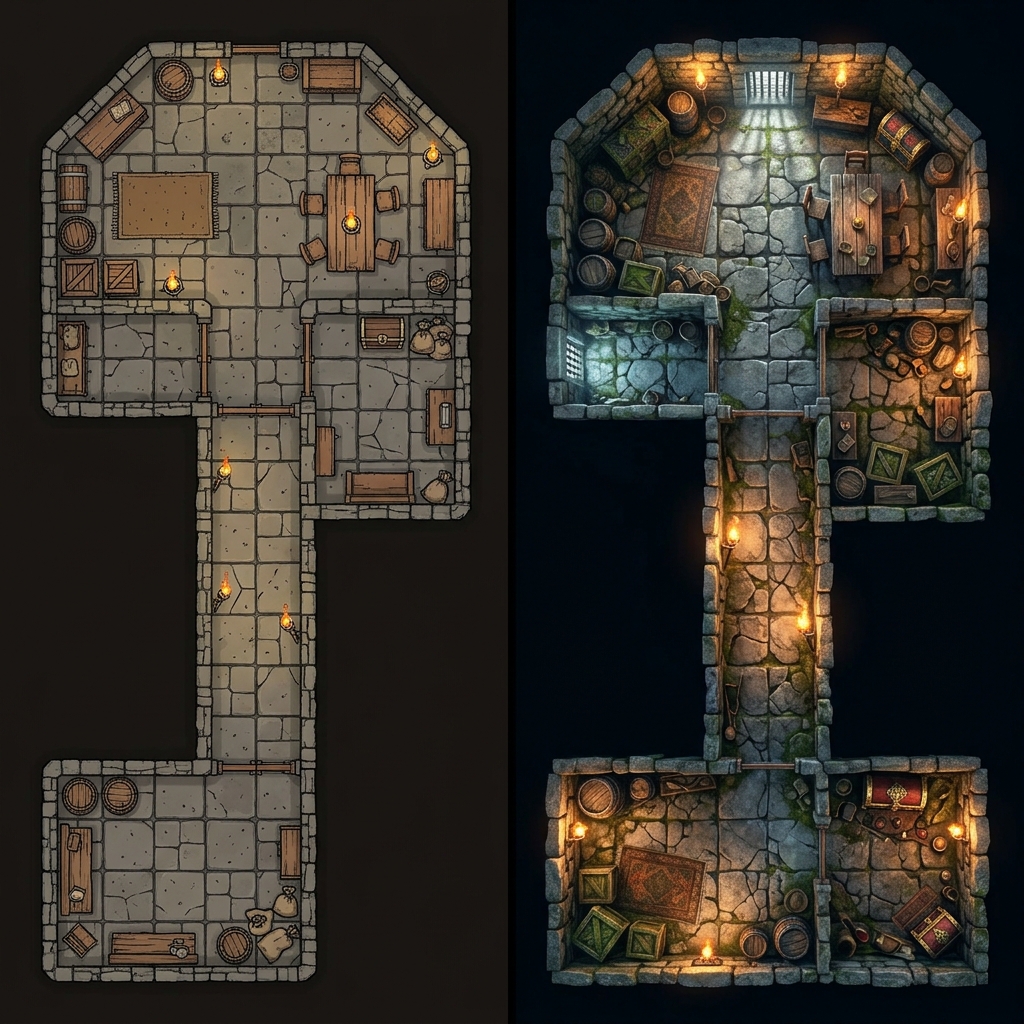
Game prep is a constant, weekly tug-of-war between your grand narrative vision and the ticking clock of real life. You want your players to gasp in awe when you reveal the hidden temple or the gritty tavern, but you also have a job, a family, and maybe only a handful of hours to actually prepare for Friday night's tabletop RPG session.
When searching for the right digital tools to build out your encounters, you inevitably run headfirst into the great debate of manual control versus raw speed. If you are reading this, you are probably looking for a viable Dungeondraft alternative or at least weighing the merits of an AI map generator vs Dungeondraft for your current campaign. Both approaches have fiercely loyal advocates on Reddit and Discord, and both serve entirely different workflows for game masters. Let us break down exactly when you should spend an evening placing individual cobblestones by hand, and when you should let an algorithm do the heavy lifting.
What Dungeondraft Does Well
Any fair Dungeondraft review has to start by acknowledging the software's undisputed champion trait: absolute, unyielding control. When you launch the program, you are stepping into a digital cartography studio where every single element on the canvas is yours to command. If you want a broken stool exactly three inches from a blood-stained rug, angled at exactly forty-two degrees next to a flickering fireplace, Dungeondraft lets you execute that vision perfectly.
The software excels in granular asset placement. You build your terrain layer by layer, dropping walls, laying down floor textures, and scattering clutter exactly where your encounter's tactical narrative demands. This level of meticulous, micro-level design is deeply satisfying for game masters who view map making as a relaxing hobby in itself.
Then there is the ecosystem. The community surrounding the software is massive, deeply entrenched, and highly passionate. Independent creators produce thousands of custom asset packs, allowing you to tailor the visual aesthetic of your battle maps to highly specific genres. Whether you are running a neon-soaked cyberpunk heist, a historical pirate adventure, or a whimsical feywild romp in a fifth edition compatible game, there is likely an asset pack designed just for it.
Finally, the pricing model remains a breath of fresh air in an era completely dominated by recurring software subscriptions. A single, one-time purchase grants you a lifetime license. You own the software forever on your machine, which makes it an incredibly cost-effective desktop tool for game masters who plan to run campaigns for decades to come.
Where Dungeondraft Slows You Down
However, that absolute, pixel-perfect control comes with a remarkably steep cost: your free time. Building a highly detailed, immersive battle map entirely by hand is not a quick process. If your party unexpectedly goes off the rails and you suddenly need a multi-level tavern, a bustling market square, and a hidden cultist crypt all for tomorrow night's session, Dungeondraft is going to demand hours of your evening. The learning curve, while certainly not insurmountable, requires genuine dedication. You have to learn the intricacies of the wall tools, figure out the ambient lighting engine, and understand how terrain layers interact to make a natural environment look organic rather than like a stamped, repetitive pattern.
Furthermore, out of the box, you are somewhat locked into its distinct, comic-book-style default art. While undeniably charming, it might not fit the grim, horrific tone you desperately need for a Call of Cthulhu investigation or the stark, dying-world aesthetic of a Mörk Borg dungeon crawl.
Overcoming this stylistic limitation means diving headfirst into the complex world of third-party asset packs. Finding, organizing, tagging, and installing these packs takes even more of your limited prep time. While many community assets are free, the highest quality modular pieces often require monthly Patreon subscriptions or separate one-off purchases on digital storefronts, subtly increasing the true cost of your mapping workflow. If you find yourself spending more time managing zip files and asset folders than writing plot hooks, you might naturally start searching for a faster Dungeondraft alternative.
What AI Map Generation Does Well
This is exactly where artificial intelligence steps into the spotlight to relieve the burden of prep. If manual map making is a meticulous oil painting that takes weeks to dry, AI map generation is a high-speed Polaroid. The most obvious, game-changing benefit is raw speed. You can easily go from a blank screen to a fully realized, high-resolution battle map in a matter of seconds. You simply type a text prompt describing a moonlit smuggler's cove, an abandoned sci-fi airlock, or a lava-filled goblin throne room, and the tool delivers it instantly.
Beyond sheer speed, AI grants you immediate access to virtually infinite art styles without ever opening a digital storefront or managing a single asset pack download. Need a photorealistic desert canyon? Done. A soft watercolor elven treetop village? Easy. A sketchy, high-contrast black-and-white layout for a brutal Shadowdark session? It is all just a matter of slightly tweaking your text prompt (our Shadowdark map inspiration guide has twelve grimdark examples ready to steal). You never have to worry about mismatched asset styles clashing jarringly on the same digital canvas.
Of course, not all AI tools are created equal for TTRPG prep. General, broad-purpose image generators often output maps at weird, unplayable isometric angles or bake in useless grids and strange, distorted NPC character models that ruin the illusion. This is exactly why using purpose-built tools is essential for game masters. For instance, Text to Tabletop is specifically engineered from the ground up for the tabletop experience. It automatically enforces a strict 90-degree top-down perspective lock, ensuring the map is actually playable on your virtual tabletop of choice. It also automatically strips out unwanted grids and accidental character generations by default, giving you clean, empty, ready-to-use terrain every single time you hit generate.
Where AI Map Generators Fall Short
But let us be brutally honest about the current limitations of the technology. If you are comparing an AI map generator vs Dungeondraft strictly on the metric of precise, tactical control, the AI will lose every single time. An AI generator works by understanding broad descriptive concepts and stylistic requests, but it absolutely does not understand that your rogue specifically needs a pile of wooden crates exactly five feet high located precisely adjacent to the tavern's back door to execute a planned flanking maneuver.
With AI, you generally cannot place a single chair or barrel manually. You lack per-pixel control over the specific environment. If the AI generates a gorgeous, atmospheric throne room but decides to put a weirdly shaped pillar right in the dead center of your intended boss fight arena, you cannot easily drag and drop that pillar out of the way. You generally have to reroll the entire image prompt or take the output into an external photo editor like Photoshop to clone-stamp the mistake away.
Additionally, because AI generates flat, two-dimensional images based on pixel data, it does not possess the underlying environmental geometry that advanced virtual tabletops love. You cannot natively export 3D wall data, dynamic lighting coordinates, or line-of-sight blockers directly from a simple text prompt. You are making a conscious trade: sacrificing micro-level architectural precision for macro-level speed and unparalleled visual flair.
The Honest Verdict: Use Both
Ultimately, framing this software debate as a winner-takes-all deathmatch is the wrong approach entirely. The most efficient, relaxed game masters do not lock themselves into a single ecosystem; they build a versatile toolkit. Dungeondraft and AI map generators are not direct replacements for one another-they are deeply complementary tools that solve different prep problems.
Use Dungeondraft for your "hero maps." These are the massive, intricate, highly tactical locations your players will visit repeatedly throughout the campaign. The party's customizable home base, the sprawling multi-level dungeon that anchors your entire plot arc, or the carefully balanced, trap-filled arena for the final campaign boss fight. These vital locations deserve the hours of meticulous, hand-crafted attention because you will get a significant return on that massive time investment over multiple sessions.
Use AI generation for absolutely everything else. Random encounters on the King's road, sudden player deviations that catch you off guard, one-shot side quests, or that dreaded moment when the party decides to kick down the door of a random potion shop you never intended them to actually enter. When you need a high-quality, thematic battle map right this second, AI is your best friend.
For a broader look at how different map-making software stacks up in the current landscape, you can check out our deep-dive breakdown of Text to Tabletop vs Inkarnate vs Dungeon Alchemist.
Stop letting weekly session prep consume your entire weekend. If you want to experience exactly how fast you can generate stunning, perfectly top-down battle maps tailored to your specific tabletop RPG campaign setting, it is time to add the right tool to your GM toolkit. Head over to Text to Tabletop and start generating your next random encounter for free. Your players will love the incredible visuals, and you will love finally having your Friday afternoon back.
Tyler V
Lead Developer and UX Designer at Text to Tabletop. Passionate about helping GMs and players create better TTRPG experiences.
Ready to Forge Your Next Battle Map?
Describe the encounter and get a grid-aligned, top-down battle map in seconds, then regenerate any area until it matches your vision.
Generate Your First Map Free3 free map tokens · no credit card required