Daggerheart Battle Maps: Ranges, Zones, and AI Map Ideas
If you are searching for Daggerheart battle maps, you have probably hit the same question as thousands of other Game Masters converting from fifth edition: does a game without a grid even use maps? Daggerheart, the roleplaying game from Darrington Press and the Critical Role team, measures combat distance in narrative range bands called Melee, Very Close, Close, and Far rather than counting five-foot squares. That design choice makes traditional gridded maps feel out of place, and plenty of new tables conclude that maps are simply not part of the game. They are missing out.
In this guide, we will look at what the official rules actually say about maps, how to run range bands on a gridless battle map, and why AI generation happens to suit the system unusually well. We will then share five copy-paste prompts tuned to the game's vibrant high-fantasy tone, and close with a note on keeping pace with the Hope & Fear expansion arriving later this month.
Does Daggerheart need a battle map?
The short answer is no, but the honest answer is that the game supports maps enthusiastically. The official rules include a dedicated section titled Maps, Range, and Movement, and Darrington Press publishes official blank battle map PDFs for tables that want them. Maps are not required equipment; they are an encouraged option. That puts it in the opposite corner from a grid first tactical system, where the squares are load bearing: our guide to Draw Steel battle maps covers what changes when the grid is mandatory.
What a map does in this system is anchor the fiction. Range bands work beautifully in pure theater of the mind until the fifth round of a chaotic fight, when someone asks whether the bridge was behind them or ahead of them and three players give three different answers. A single top-down image settles the question instantly. The map does not need to measure anything; it needs to show everyone the same scene, so that when the Game Master says an adversary is Far away across the ravine, every player pictures the same ravine.
How range bands work on a gridless map
Because Daggerheart does not count squares, the map becomes a reference picture rather than a measuring tool, and running ranges on it is easier than most converts expect. A simple table technique works well: tokens touching each other are in Melee, a token a short hop away is Very Close, most of the visible scene is Close, and anything near the far edges of the map is Far. Terrain features make natural boundaries, so a stream, a tree line, or a collapsed wall can informally mark where Close ends and Far begins. Your players internalize this within a session or two.
Digital tables have caught up quickly. Roll20 added a dedicated Range Scale measurement mode for the game, Fantasy Grounds support launched in April 2026, and Foundry VTT has an active community system called Foundryborne. Whichever platform you use, the import workflow is the same one covered in our guide on how to use AI maps in VTT platforms; you simply skip the grid alignment step entirely.
This is also where AI generation fits the system so naturally. Text to Tabletop strips pre-baked grids out of every map it generates, which is normally a convenience for grid alignment in a VTT. For Daggerheart it is the whole point: the AI battle map generator produces exactly the clean, gridless scene the range band system wants, with no squares to ignore and no lines fighting the artwork.
Five Daggerheart map prompts
Daggerheart's art direction leans lush, vibrant, and hopeful, closer to a painted storybook than the muted grimdark palette of many dungeon crawlers. The prompts below lean into that tone. Each one is gridless by design, and each scene includes terrain features you can use as informal range markers at the table.
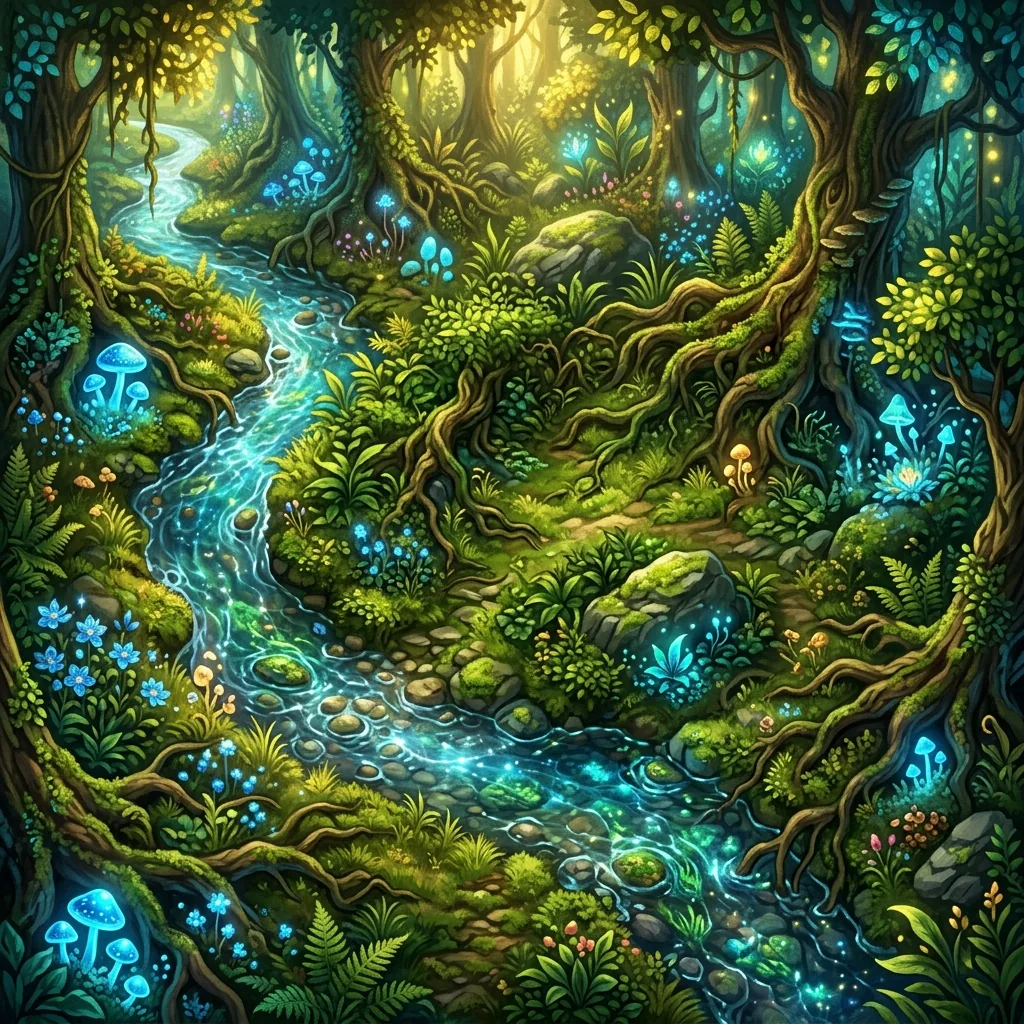
1. The overgrown forest clearing
An ancient forest heart where the wilderness has grown strange and luminous, perfect for a first session or a fey encounter.
- The Setup: Giant twisting tree roots divide the clearing into natural lanes, a winding stream marks a boundary the party can defend, and glowing flora gives the Game Master light sources to describe.
- The Prompt: "Top-down battle map of a lush overgrown forest clearing, giant twisting tree roots, bioluminescent glowing flowers, a winding clear stream, moss-covered boulders, vibrant greens, dappled golden light, gridless digital art."
2. The cliffside coastal village
A terraced fishing village clinging to sea cliffs, ideal for social scenes that erupt into sudden combat.
- The Setup: Stacked terraces create three distinct elevation levels, and the rope bridges between them are obvious choke points. Anything on another terrace reads naturally as Far.
- The Prompt: "Top-down battle map of a cliffside coastal village, whitewashed cottages on stone terraces, rope bridges between ledges, turquoise sea below, fishing nets and market stalls, bright afternoon sunlight, gridless digital art."
3. The glowing cavern shrine
A hidden underground sanctuary where something old is worshipped, suited to quiet revelation or a desperate last stand.
- The Setup: A ring of still water surrounds the central shrine, forcing attackers through two narrow stone causeways while crystal light keeps the scene readable.
- The Prompt: "Top-down battle map of an underground cavern shrine, luminous blue crystals, central stone altar ringed by still dark water, narrow rock causeways, hanging moss, soft teal glow, gridless digital art."
4. The storm-wracked ruin
A shattered keep in a howling storm, built for a climactic confrontation with the weather itself as a character.
- The Setup: Broken walls provide scattered cover, rain-slick flagstones justify dramatic movement complications, and the storm gives the Game Master license to change the battlefield between rounds.
- The Prompt: "Top-down battle map of a ruined stone keep in a thunderstorm, shattered walls, rain-slick flagstones, fallen tower debris, wind-bent trees, flashes of lightning, dramatic cool lighting, gridless digital art."
5. The river crossing ambush
A shallow ford in deep wilderness, the classic ambush site for a party mid-journey.
- The Setup: The ford itself is the objective, with dense ferns on both banks concealing attackers and a fallen log offering a faster but riskier crossing.
- The Prompt: "Top-down battle map of a forest river crossing, shallow ford with stepping stones, dense ferns and undergrowth on both banks, a fallen log bridge, scattered river rocks, late golden light, gridless digital art."
If you want to push further afield, our collections of fantasy battle maps and wilderness encounter maps are full of scenes that translate directly into this system; just generate them without a grid.
Keeping pace with Hope & Fear
There has never been a better moment to build a Daggerheart map library. The game's first major expansion, Hope & Fear, releases on August 25, 2026, bringing four new classes, over 130 adversaries, and 28 environments. That is 28 distinct places your table might visit, and no map pack on the market will cover them all on day one. A generator that turns a written description into a finished scene in seconds is the only prep tool that can genuinely keep pace with a book that size.
Whether your party is wading through a glowing forest or holding a storm-wracked ruin against the dark, a gridless map keeps everyone imagining the same scene without slowing the fiction down. To build your own, sign up for the Text to Tabletop app today and start generating custom maps in seconds.
Tyler V
Lead Developer and UX Designer at Text to Tabletop. Passionate about helping GMs and players create better TTRPG experiences.
Ready to Forge Your Next Battle Map?
Describe the encounter and get a grid-aligned, top-down battle map in seconds, then regenerate any area until it matches your vision.
Generate Your First Map Free3 free map tokens · no credit card required