Wilderness Battle Map Design: Forests, Mountains, and Hex-Crawl Hazards
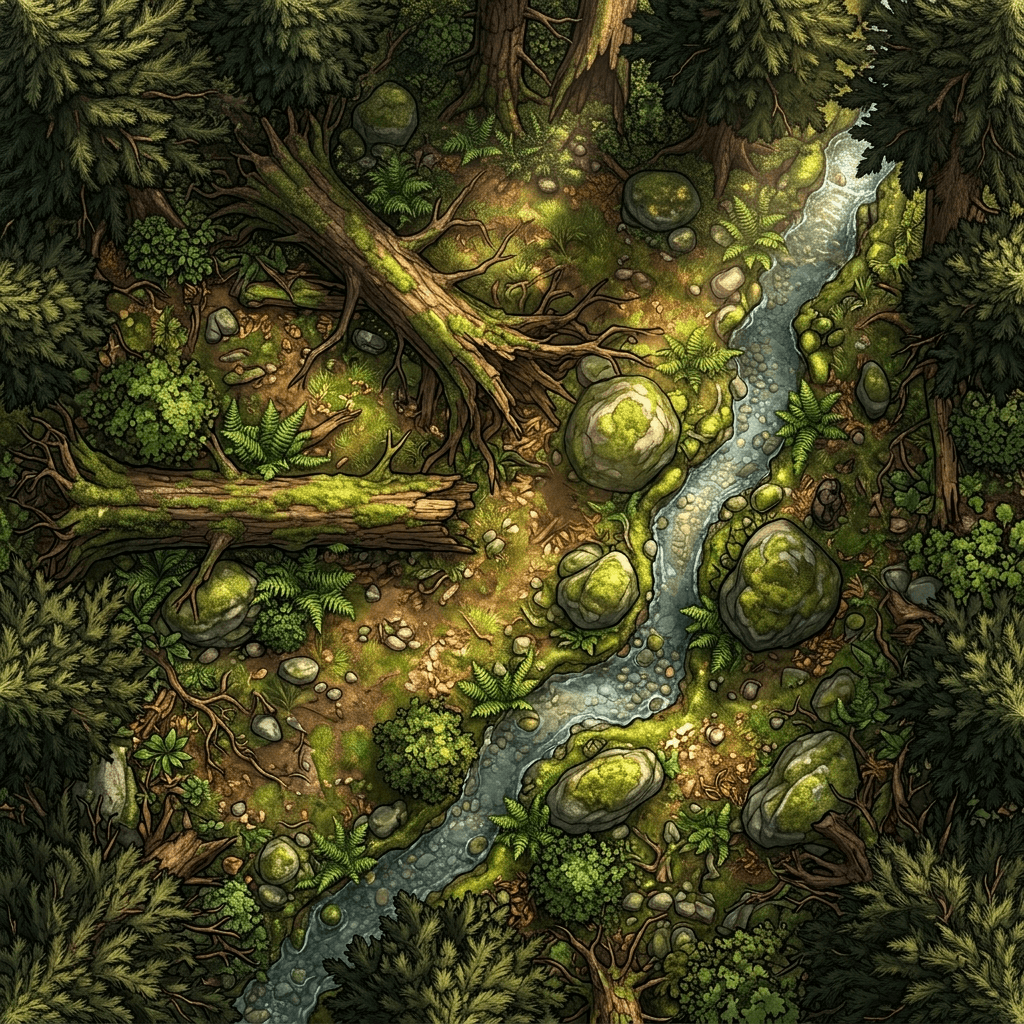
When running a tabletop RPG, it is easy to treat wilderness travel as a narrative transition. When combat occurs in the wild, it often defaults to an empty field where characters stand and trade blows, stripping away the mechanical depth of outdoor survival. A well-designed wilderness battle map can transform a simple travel detour into a memorable tactical challenge. By introducing natural cover, elevation changes, and environmental hazards, GMs can force players to think about movement, positioning, and their surroundings.
In this guide, we will break down what outdoor encounters need to remain engaging. We will also highlight six wilderness biomes with ready-to-use prompts and discuss how to pre-generate a library of layouts to streamline your hex crawl campaigns.
What Every Wilderness Battle Map Needs
Designing for the outdoors requires a different mindset than building dungeon corridors. Caverns and castle walls provide natural boundaries that dictate movement. In the wild, you must construct these boundaries using natural terrain. To make your outdoor battle map feel tactical, focus on four key elements.
First, you need natural cover. Instead of stone pillars, use thick tree trunks, moss-covered boulders, dense brambles, and dirt mounds. These elements should offer varying degrees of protection, from standard cover (+2 AC) behind a large oak tree to lesser cover (+1 AC) from a low hedge. Scattering these obstacles encourages ranged characters to move between covers rather than standing in the open, turning combat into a dynamic shootout.
Second, elevation changes are essential. Natural landscapes are rarely perfectly flat. Introduce rocky ledges, steep hillsides, sunken ravines, and raised earthen mounds. These features create immediate tactical value, granting height advantages to ranged attackers and forcing melee combatants to navigate steep slopes that require Athletics checks to scale. Controlling the high ground should be a major objective for both the party and their enemies.
Third, you must incorporate environmental hazards. The wilderness itself should feel dangerous. A fast-flowing river, a patch of quicksand, a field of thorny briars, or a freezing swamp path can act as active hazards. These features should restrict movement, act as difficult terrain, or deal minor damage, forcing characters to adapt their plans. A druid might exploit these hazards by using magic to push enemies into quicksand.
Finally, design for sight-line variety. A dense old-growth forest battle map should restrict sightlines with thick foliage and low canopy, making surprise ambushes possible, and our guide to road ambush battle maps breaks down the five features an ambush site needs. In contrast, an open moor should offer long sightlines with scattered rock outcrops, forcing players to manage long-range attacks and approach routes carefully.
Six Wilderness Biomes with Combat-Ready Layouts
To help you build these settings, here are six wilderness biomes. Each setup features a description of its tactical value and a prompt designed for a modern ai battle map generator.
1. Old-Growth Forest
Dense forests are about close-quarters skirmishing and breaking lines of sight. When you place a party in an old-growth forest, you want to create organic pathways using trees and rock formations. The thick foliage and towering trunks provide plenty of cover, making ranged attacks harder and encouraging close combat. Fallen logs serve as natural barriers, while small streams act as minor water hazards that slow down movement.
- The Setup: Massive pine trees ring the clearing, while two fallen logs create natural chest-high walls across the center. A small stream cuts diagonally across the forest battle map.
- The Prompt: "Top-down battle map of a dense old-growth forest clearing, massive pine trees, two large fallen logs, scattered boulders, a diagonal small stream, ferns and undergrowth, dappled sunlight, gridless digital art."
2. Marshland and Swamps
Swamps are defined by difficult terrain and hidden water hazards. The murky water makes it difficult to see what lies beneath, adding an element of suspense to every step. Path selection is critical, as stepping off the trail can trap a character in deep mud, making them easy targets.
- The Setup: The characters must navigate narrow tussock paths. Surrounding deep mud pools act as greater difficult terrain that can pull characters under.
- The Prompt: "Top-down swamp battle map, narrow muddy paths, dark green stagnant water pools, cypress trees with hanging moss, thick fog, dim overcast lighting, 90-degree overhead view."
3. Mountain Pass
Mountain paths are highly vertical and restrict movement to narrow lanes. Combat here is defined by high cliffs and narrow pathways. A single push or fall can be fatal, making positioning extremely important. Characters must watch for loose rocks and falling debris.
- The Setup: A steep rocky trail winds between towering cliff faces. Loose rock piles indicate areas where landslide hazards can occur.
- The Prompt: "Top-down mountain pass battle map, winding gravel trail, sheer stone cliff edges, loose rock debris, sparse mountain pine trees, bright morning sunlight, shadows cast by cliffs, gridless fantasy art."
4. River-Crossing Ford
Fords present immediate tactical choices: take a slow, dangerous water crossing or hold the banks. Rushing water acts as a natural barrier that divides the battlefield. Characters crossing the river must battle the current while defending against attackers on the shore.
- The Setup: A shallow gravel ford allows characters to cross a rushing river, but the strong current requires strength checks to stand.
- The Prompt: "Top-down river crossing battle map, shallow gravel ford, rushing blue water with white rapids, forested riverbanks, scattered river stones, bright midday lighting, overhead perspective."
5. Open Moor and Standing Stones
Moors offer long-range sightlines with centralized, heavy cover. The open plain leaves characters exposed to ranged attacks, making the central stone circle a critical defensive position. Players must coordinate their advance to reach cover safely.
- The Setup: An open field of heather is centered on a circle of ancient stone pillars, which provide the only source of cover in a wide-open plain.
- The Prompt: "Top-down battle map of an open grassy moor, a central ring of tall stone monoliths, scattered boulders, purple heather wildflowers, overcast sky with soft lighting, gridless digital art."
6. Frozen Tundra
Tundra encounters combine slipping hazards with sheer chasms. The frozen ground is slick, making fast movement risky. Crevasses divide the battlefield, forcing characters to find bridges or make dangerous jumps.
- The Setup: A snow-covered plain is split by a deep crevasse. Patches of smooth ice act as hazards that can cause characters to fall prone.
- The Prompt: "Top-down frozen tundra battle map, snow-covered ground, deep ice crevasse, patches of slick blue ice, scattered snowdrifts, cold blue winter dawn lighting, overhead perspective."
Hex Crawl Random Encounter Maps
If you run a sandbox campaign, players will constantly explore new territories, making it difficult to predict where combat will occur. Instead of generating a map during the session, we recommend pre-generating a stack of 20 to 30 wilderness encounter maps in advance.
By categorizing these layouts by biome (such as forest, desert, or mountain), you can quickly pull a map from your library the moment a random encounter is triggered. Having a pre-made hex crawl map for each region of your world means you never have to pause the game to sketch out a scene. This preparation keeps your game pace fast. If your players decide to head toward civilization, check out our guide on designing city and urban battle maps to see how town layouts compare to open wilderness.
For GMs looking for inspiration across different settings, you can check our comprehensive catalog of fantasy battle maps to build out your campaign library. If you are deciding whether to run those hexes as your combat grid as well, our comparison of hex grid vs square grid battle maps covers where each one wins, and when a random encounter turns into a raid on the people responsible, our bandit camp layout guide has the site ready. If the party heads down rather than across, our guide to underdark battle maps covers six environments by depth.
Seasonal Variations and Weather
To make your outdoor settings feel alive, consider how seasons change the terrain. The same forest clearing can offer different tactical challenges in summer, autumn, and winter.
In summer, thick foliage provides heavy cover. In autumn, dry leaves make stealth harder. In winter, snow acts as difficult terrain, and frozen water can break, creating hazards.
Additionally, weather elements like fog, heavy rain, or howling blizzards alter visibility and range. For example, dense fog can restrict visibility to thirty feet, turning a long-range archery duel into a close-quarters struggle, while heavy rain makes climbing rocky surfaces much more difficult.
To build these diverse settings instantly, visit the Text to Tabletop app. The tool automatically enforces a 90-degree overhead lock and strips out grids and NPCs, allowing you to generate a playable wilderness battle map in seconds. Sign up at the Text to Tabletop app today and start designing your next outdoor adventure!
Tyler V
Lead Developer and UX Designer at Text to Tabletop. Passionate about helping GMs and players create better TTRPG experiences.
Ready to Forge Your Next Battle Map?
Describe the encounter and get a grid-aligned, top-down battle map in seconds, then regenerate any area until it matches your vision.
Generate Your First Map Free3 free map tokens · no credit card required