What Is a Battle Map? The Tactical Map Your Table Actually Needs
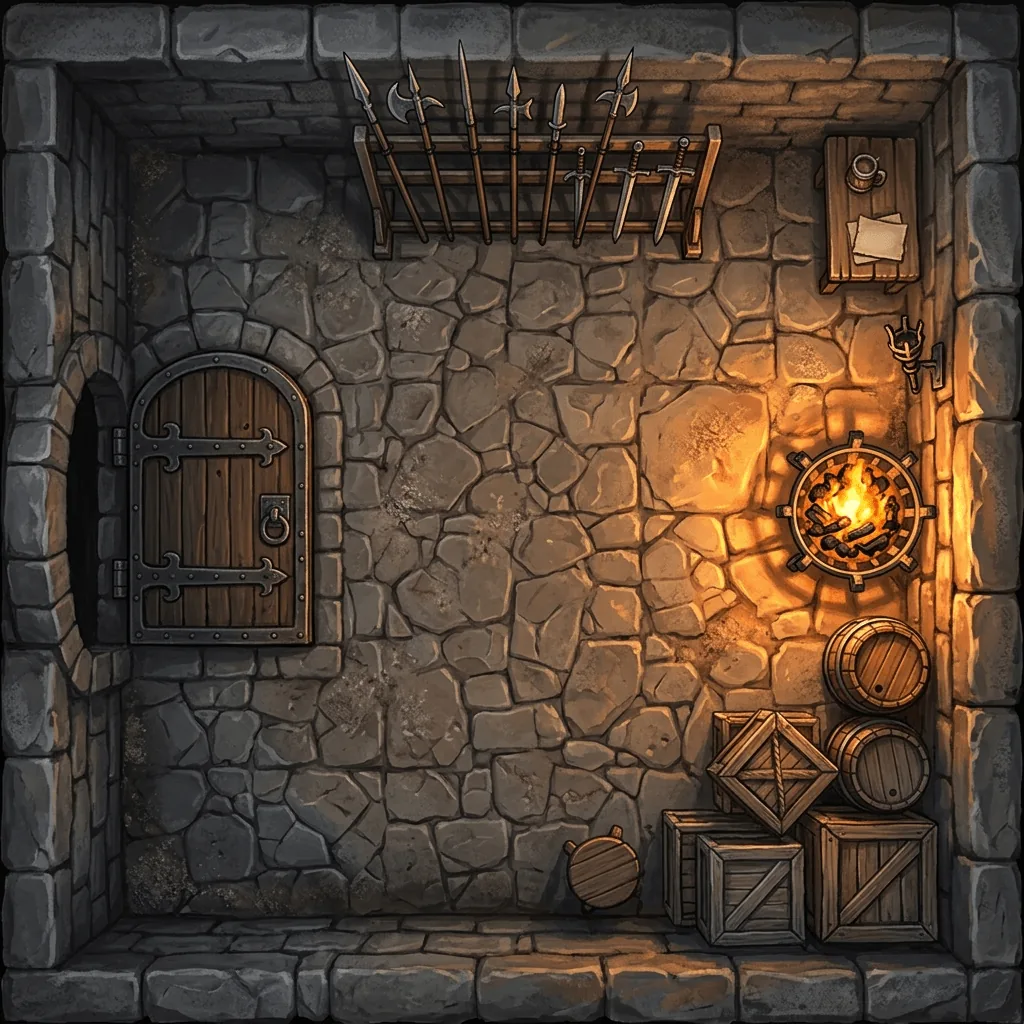
Ask five Game Masters what a battle map is and you will get five answers that all circle the same idea without landing on it: the grid thing, the printed poster, the picture you drop into Roll20, the dry-erase mat with the marker smudges. All of those are battle maps. None of those is the definition.
This guide gives you the plain answer, then everything that follows from it: how a battle map differs from the other maps in your campaign, what size one should be, whether you actually need one, and how Game Masters get hold of them in 2026.
What is a battle map?
A battle map is a scaled, top-down map of a single location, drawn so that miniatures or virtual tokens can stand on it during combat. The scale is the part that matters: on almost every tabletop RPG battle map, one square equals five feet, which is why a battle map can answer questions a picture cannot. Who is in range. Who has cover. How many turns it takes to cross the room. It is a map you measure on, not a map you look at.
Everything else about a battle map follows from that one requirement. The viewing angle is a strict ninety degree overhead, because a tilted view distorts distance and makes the squares lie. The area covered is small, usually a single room, clearing, street, or deck, because at five feet per square a whole town would not fit on a table. And the detail level is high, because at that zoom the players can see individual crates, and those crates are cover.
Battle map vs dungeon map vs world map
The three map types in a campaign answer three different questions, and most confusion about battle maps comes from mixing them up.
| Map type | Scale | Covers | Used for |
|---|---|---|---|
| Battle map | 5 feet per square | One room, street, or clearing | Running a combat encounter |
| Dungeon map | Roughly 10 to 20 feet per square | A whole complex, floor by floor | Navigation, exploration, GM reference |
| World map | Miles per inch | A region or continent | Travel, campaign geography |
A dungeon map is the floor plan: twenty rooms, corridors, and a legend, drawn so the Game Master can track where the party is. A battle map is one of those rooms, blown up until a figure fits inside a square. In practice you use both, and the handoff between them is the moment a session goes from exploration to combat. Our guide to the 5-room dungeon method shows that handoff in action: one small dungeon layout, five encounters, five battle maps.
A world map is a different animal entirely, and it is worth saying plainly that it is not what this site makes. Battle maps are the tactical layer, and the skills, sizes, and tools involved barely overlap with continent cartography.
Do you need a battle map for 5e?
No rule requires one. Fifth edition combat is written so that it can be run in your head, and plenty of long-running tables never draw a square. What a battle map buys you is precision, and precision matters most in exactly three situations.
The first is any encounter where position is the point: a chokepoint defense, a room with a pit in the middle, an ambush that only works if the party has walked past the cover. The second is any encounter with an area effect, because the difference between a fireball catching two enemies and catching five is a conversation nobody wants to have from memory. The third is any table with a newer player, since seeing the board is the fastest way to learn what your character can do on a turn.
The honest counterweight is pacing. A map takes time to set up, and a five minute setup for a two minute fight is a bad trade. Many Game Masters run the middle path: describe the small fights, draw the big ones. If you want the full argument on both sides, our comparison of theater of the mind and battle maps lays out when each one wins.
What size is a battle map?
Start with movement. A typical character moves thirty feet per turn, which is six squares, so map size is really a question about how many turns the two sides spend closing the distance.
Around 20 x 20 squares suits a tight interior fight: a guardroom, a cellar, a shrine with one door. Around 30 x 30 squares is the comfortable default for most encounters, with room for flanking and a retreat that takes more than one turn. Around 40 x 30 squares fits roads, riverbanks, and ship decks, where the shape of the space is the encounter. Beyond that you are usually just adding rounds of walking.
Those squares translate into pixels for a virtual tabletop and into inches for print, and the conversions are where most battle map problems actually start. Our battle map size guide has the full lookup table for all three unit systems.
Gridded or gridless?
A battle map can ship with grid lines drawn into the image or without them. The distinction matters more than it sounds. Virtual tabletops draw their own grid, so a baked-in grid usually ends up slightly misaligned with the software grid, giving you two sets of lines that never quite agree. Printed maps, on the other hand, need the grid in the image, because paper has no software to draw one.
The practical rule is to keep a gridless master image and add a grid only when you print. Our breakdown of gridded and gridless battle maps covers the decision in detail, including how to handle the double grid problem.
Where Game Masters get battle maps
There are four realistic sources, and most tables end up using more than one.
Free map libraries. Community artists and subscription studios release enormous back catalogs, and a great deal of it is free. The limitation is search: you are looking for a scene that matches what you wrote, and the library has what it has. Our roundup of free battle map sources covers the best of them.
Paid map packs. Studios like Czepeku and 2-Minute Tabletop sell themed sets at a high artistic standard. Excellent value if your campaign happens to match the theme.
Drawing your own. Tools like Dungeondraft, Inkarnate, and Dungeon Scrawl give you total control in exchange for time. A detailed hand-built map is an evening of work, which is why most Game Masters reserve this for set pieces.
Generating them. Describe the scene in a sentence and get a finished top-down map back. This is the newest option and the one that solves the search problem, because the map matches what you wrote rather than what somebody else happened to draw. Our walkthrough on how to make AI battle maps covers the workflow from prompt to VTT import.
The one thing that makes a battle map good
Whatever source you use, the test is the same: can a player look at the map and immediately see two or three things worth doing? A room with a door and four walls gives them one option, which is to walk forward and swing. A room with a pillar, a spilled cart, a raised walkway, and a second exit gives them a plan. Terrain is the difference between a map and a backdrop, and it is the single most useful thing to think about before you draw, buy, or generate anything.
When you are ready to put a specific scene on the table instead of the closest match you could find, sign up for the Text to Tabletop app, claim your 3 free tokens, and generate a battle map of exactly the room your next encounter happens in.
Tyler V
Lead Developer and UX Designer at Text to Tabletop. Passionate about helping GMs and players create better TTRPG experiences.
Ready to Forge Your Next Battle Map?
Describe the encounter and get a grid-aligned, top-down battle map in seconds, then regenerate any area until it matches your vision.
Generate Your First Map Free3 free map tokens · no credit card required