What Is Text-to-Map AI? A Beginner's Guide for Game Masters
It is 9:00 p.m. on a Friday night, and your players are scheduled to arrive at your table at 9:00 a.m. tomorrow morning. You have your monster stat blocks prepared and the villain's dramatic monologue perfectly rehearsed. Suddenly, you realize the party bypassed your carefully planned forest encounter and is now marching straight toward a subterranean volcanic lair. You do not have a battle map in sight.
You could spend the next three hours scrolling through image boards, trying to find something that roughly matches your vision. You could also grab a marker and painstakingly draw a grid by hand, hoping your players can imagine the lava pits. Instead, you can type a descriptive sentence and let a computer do the heavy lifting. This is exactly where text to map AI steps in to save your session. If you are a Game Master looking to rescue your prep time and your sanity, this technology is about to become your favorite new storytelling tool.
What Is Text-to-Map AI?
At its core, text to map AI is a specialized form of artificial intelligence image generation that has been fine-tuned exclusively for tabletop RPGs. You write a brief text description of the location you need for your game, and the software translates those words into a highly detailed visual layout. It bridges the gap between your imagination and the virtual tabletop screen.
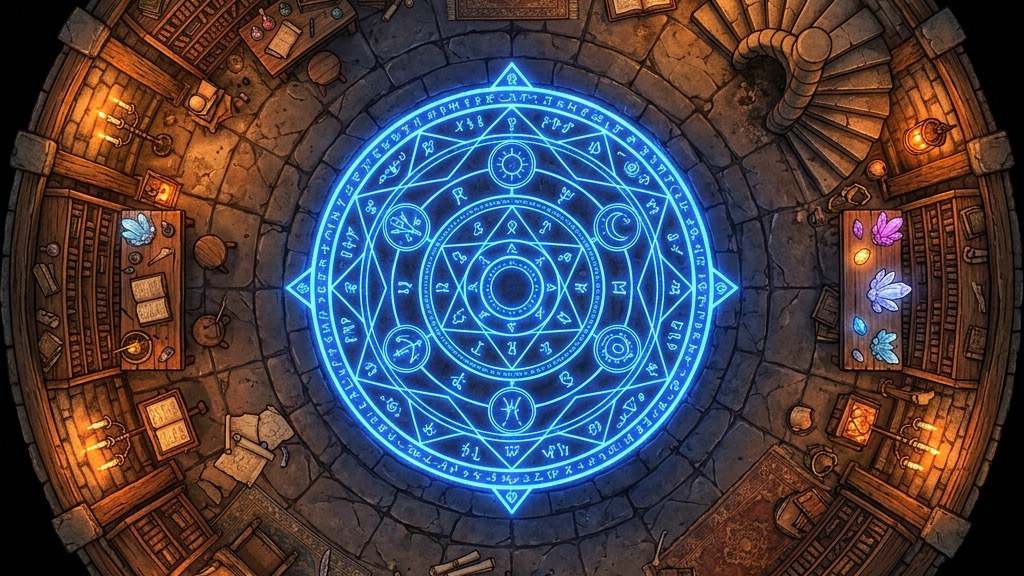
Unlike generic image generators that produce wide landscape shots or character portraits, a dedicated prompt to map AI focuses entirely on producing usable environments for tactical combat and exploration. It removes the guesswork and creates a top-down view of a forgotten dungeon, a bustling tavern, or a high-tech sci-fi cargo bay. These images are immediately ready to be dropped into your virtual tabletop software or printed out for your home game. You no longer have to compromise on your campaign setting just because you cannot find a map that fits your exact vision.
How Text-to-Map AI Works
The underlying process behind AI map generation sounds like science fiction, but it relies on a very straightforward exchange between you and the software. You begin the process by writing a prompt. This prompt is simply a short phrase detailing the environment, the time of day, the lighting, and the core structural features of the room.
Once you submit your text, the software processes your request through a large neural network that has been trained on millions of visual concepts. It interprets terms like "cobblestone floor," "bubbling lava pit," or "strewn debris" and begins constructing an image pixel by pixel based on those specific parameters.
Dedicated map generators take this underlying technology a step further. They impose strict formatting rules onto the output. The software constrains the model so you receive a functional floor plan rather than a beautiful but ultimately useless piece of concept art. It filters your text through specialized algorithms designed to prioritize architectural layout over artistic flair, ensuring the final product actually works for playing a tabletop RPG.
Why Text-to-Map AI Is Different from Generic AI Art
If you have ever tried asking a popular image generator like Midjourney or DALL-E for a battle map, you have likely experienced profound frustration. Generic AI tools simply do not understand the functional requirements of a Friday night roleplaying session. They frequently tilt the camera into an isometric angle, rendering the image completely useless for measuring character movement.
Furthermore, generic models love to generate warped, asymmetrical grids that are baked directly into the image. When you try to align these distorted squares with your virtual tabletop software, the entire map breaks down. Worst of all, generic AI tools will inevitably populate your empty dungeon with random, uninvited characters standing around like statues, ruining the immersion of your encounter.
An AI map generator built specifically for Game Masters solves these exact problems natively. Text to Tabletop uses an automatic 90-degree top-down lock to ensure the perspective is always perfect for measuring distances and tactical combat. It also explicitly strips out character silhouettes, unwanted monsters, and baked-in grid lines. You get a clean, functional battle map every single time. It is a blank slate ready for your own custom tokens and your software's pristine grid overlay.
Who Should Use Text-to-Map AI?
This technology is an absolute game changer for a wide variety of storytellers. Busy Game Masters who juggle full-time jobs, family commitments, and everyday life often lack the hours required to hunt down or illustrate the perfect campaign assets. If you run weekly fifth edition compatible games or intricate Pathfinder campaigns, an AI map generator gives you back your Friday nights.
It is also an incredible resource for Game Masters who run one-shot adventures. One-shots require fresh, unique environments for a single evening of play, and paying for premium map packs for a two-hour session is not always viable. Online play groups using digital platforms benefit immensely because the generated files are perfectly sized and instantly ready for upload.
Furthermore, Game Masters who prefer sandbox-style campaigns reap massive benefits. When your players can travel anywhere in the world at a moment's notice, you cannot possibly prep every tavern or bandit camp in advance. Text-to-map AI allows you to generate high-quality encounters on the fly without breaking a sweat or pausing the session for twenty minutes.
Getting Started: Your First Prompt
Creating your first map is a fast and incredibly intuitive process. You do not need to learn complex coding, memorize intricate tags, or master advanced graphic design software. The entire workflow is designed to feel as natural as typing a message to a friend.
To get started with your first environment, head over to the Text to Tabletop app and locate the main text box. Think about the room your players are about to enter and type a clear, descriptive sentence. For example, you might write: "A ruined stone temple deep in a swamp, overgrown with green vines, glowing purple runes carved into the floor, pools of murky water."
Hit the generate button and wait just a few seconds. The software will process your prompt and deliver a highly detailed top-down battle map matching your exact description. Because you are using a dedicated tool, the perspective is firmly locked, the distracting grid is absent, and the scene is immediately ready for action. Once you understand these basic mechanics, you can start tweaking your words to get even better results. Check out our comprehensive guide on writing the perfect AI map prompt for advanced tips and formatting tricks.
Common Misconceptions
As with any newly emerging technology, a few myths are currently floating around the tabletop community regarding text to map AI. Let us clear up the most common misconceptions so you can approach these tools with confidence.
First, some players believe AI maps always look generic and uninspired. While a lazy, two-word prompt might produce a bland rectangular room, the results are entirely dependent on your creative input. A detailed and imaginative description yields a highly specific and unique map. The more creative you are with your phrasing, the more distinctive and atmospheric the final environment becomes.
Second, there is a lingering worry that this technology replaces human artists and traditional cartographers. In reality, AI generators exist in a completely different tool category. Premium, hand-drawn cartography will always hold a place of honor in published adventure modules, high-end hardcovers, and prestigious home games. AI map generation is simply a utilitarian lifeline for homebrewing Game Masters who need quick, customized, and functional assets on a Tuesday night. That distinction between home prep and published work is the whole question, and our piece on whether AI art is acceptable for tabletop maps works through where each community and storefront draws the line.
Finally, many Game Masters assume the software involves a steep learning curve. As shown in the previous section, the barrier to entry is virtually nonexistent. If you can type a descriptive sentence about a fantasy tavern or a derelict spaceship, you already possess all the necessary skills to master this technology.
Enhance Your Next Session
Preparing for your next tabletop RPG session should be an exciting creative process, not a stressful scavenger hunt for the right visual assets. Text-to-map AI puts the incredible power of a dedicated digital cartographer right at your fingertips. You can focus your valuable energy on building compelling villains, writing engaging dialogue, and crafting intricate storylines while the software handles the floor plans. Are you ready to see this powerful technology in action and generate your first custom environment? Head over to Text to Tabletop and start creating your perfect campaign setting today.
Tyler V
Lead Developer and UX Designer at Text to Tabletop. Passionate about helping GMs and players create better TTRPG experiences.
Ready to Forge Your Next Battle Map?
Describe the encounter and get a grid-aligned, top-down battle map in seconds, then regenerate any area until it matches your vision.
Generate Your First Map Free3 free map tokens · no credit card required