Haunted House Battle Maps: Mapping a Horror One-Shot Floor by Floor
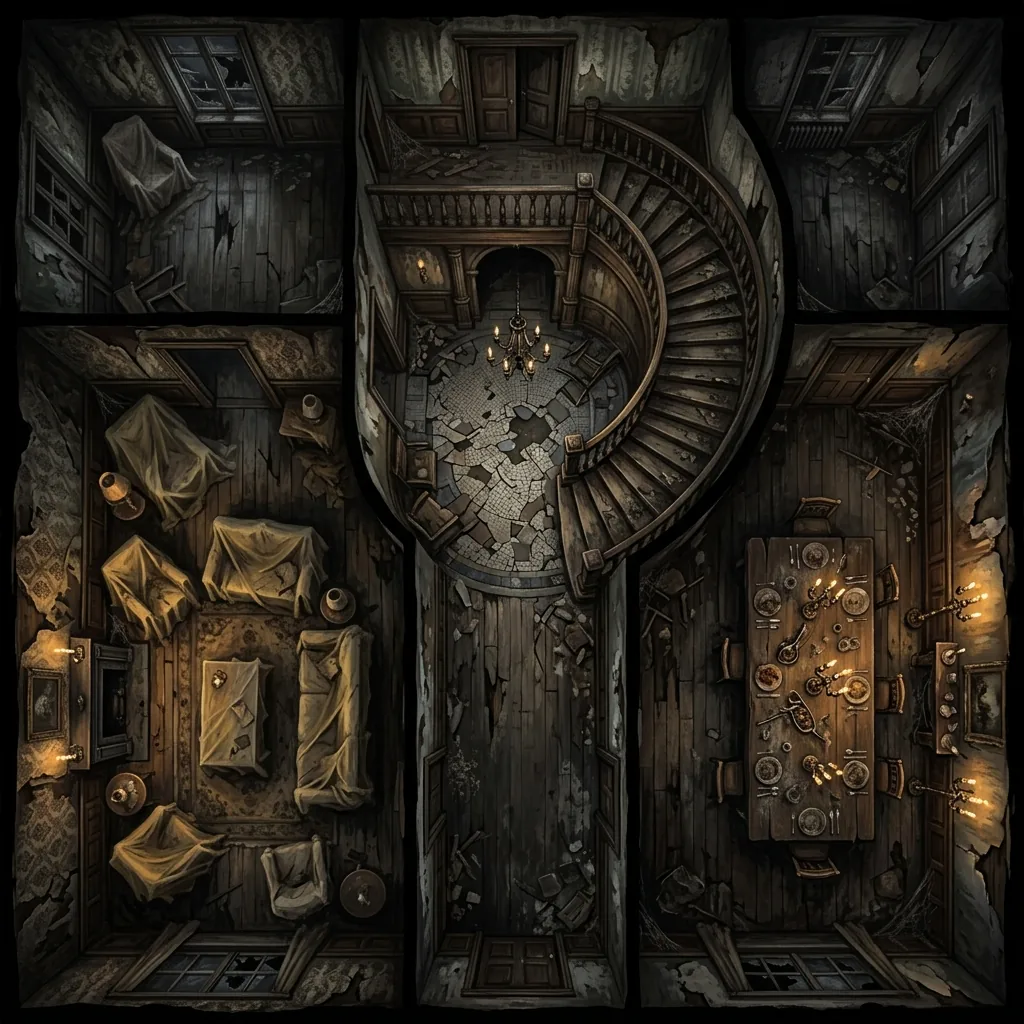
A great haunted house battle map does something no dungeon map has to do: it has to look almost normal. Skeletons and lava pits announce themselves, but a haunted mansion works by showing players a parlor, a dining room, and a nursery, then letting them notice that something about each one is quietly wrong. If you are prepping a horror one-shot this season and cannot find maps that walk that line, you are facing the same problem every horror Game Master faces: asset libraries are full of dungeons and taverns, and nearly empty of convincingly dreadful family homes.
In this guide, we will build the whole house. We will start with the design philosophy that separates a haunted house from a skinned dungeon, then work floor by floor, from the overgrown grounds down to the cellar and the thing hidden behind its false wall, with a copy-paste AI prompt for each level. We will finish with pacing advice for running the house and a technique for changing rooms mid-session as the haunt reveals itself.
A dungeon wearing a domestic mask
The design insight that unlocks every good haunted house map is this: a haunted house is a dungeon wearing a domestic mask. Structurally, it is still rooms, corridors, choke points, and a treasure at the bottom. But every element wears familiar clothing, and the horror lives in the gap between what a room is for and what it has become. A dining room is not scary; a dining room where the meal was abandoned mid-course and nobody ever cleared the table is.
This means your maps should be furnished like homes, not like encounter arenas. Prompt for the mundane objects a family would own, then introduce one or two details per room that sit wrong: a chair facing a corner, a child's toy on the stairs of a childless house, doors of slightly different sizes along the same hallway. As we argue in our Call of Cthulhu map design guide, restraint is the whole trick, so keep blood and bodies off the canvas and let clean, wrong rooms do the work while your narration fills in the dread.
Floor by floor: prompts for the whole house
The prompts below build one coherent mansion, from the fence line to the foundations. Generate them in an AI battle map generator as a set so the style stays consistent, and your players can descend through the entire property in a single session.
1. The grounds and the covered porch
Horror starts at the property line, and an exterior map gives your players a chance to circle the house and dread it properly.
- The Setup: A rusted iron fence encloses an overgrown garden where the hedges have gone feral, a dry fountain stands off-center in the yard, and a deep covered porch wraps the house in permanent shadow.
- The Prompt: "Top-down battle map of an overgrown mansion grounds, rusted iron fence, feral hedges, dry stone fountain, cracked flagstone path, deep covered porch in shadow, dead ivy on walls, overcast gray light, muted colors, gridless digital art."
2. The ground floor
The ground floor is the mask at its most convincing: a fine home, only slightly decayed, that wants visitors to come further in.
- The Setup: A grand foyer with a sweeping staircase opens onto a parlor of sheet-covered furniture, while the dining room table is still set for a meal that was abandoned between courses, chairs pushed back in a hurry decades ago.
- The Prompt: "Top-down battle map of a decaying mansion ground floor, grand foyer with sweeping staircase, parlor with sheet-covered furniture, dining room with abandoned half-finished meal, peeling wallpaper, cold fireplace, candlelight pooling in corners, muted palette, gridless digital art."
3. The upper floor
Upstairs, the house keeps up appearances, but the geometry has started to slip.
- The Setup: Bedrooms and a nursery open off a central hallway that is slightly too long for the building that contains it, with more doors than the outside walls should allow.
- The Prompt: "Top-down battle map of a mansion upper floor, master bedroom with four-poster bed, faded guest rooms, nursery with rocking cradle, unnaturally long central hallway with too many doors, threadbare carpet runner, moonlight through dusty windows, desaturated colors, gridless digital art."
4. The attic
The attic is the house's memory: everything the family put away, pressed under a low roof with a single eye of light.
- The Setup: Sloped rafters crowd rows of trunks, covered mirrors, and stacked portraits, and one small round window at the gable end lights the whole space.
- The Prompt: "Top-down battle map of a cramped mansion attic, sloped rafters, dusty steamer trunks, cloth-covered mirrors, stacked family portraits, thick dust and cobwebs, single round gable window casting one shaft of pale light, dim desaturated palette, gridless digital art."
5. The cellar and the secret shrine
The cellar is where the domestic mask comes off, and behind its false wall is the reason the house is the way it is.
- The Setup: Wine racks and preserve shelves give way to a dirt floor, and a false wall at the back of the last rack opens into a low stone shrine where candles have burned in front of a crude altar for far too long.
- The Prompt: "Top-down battle map of a mansion cellar, wooden wine racks, shelves of preserve jars, packed dirt floor, false wall opening into a hidden stone shrine, crude altar with guttering candles, scratched symbols on stone, deep shadows, warm flickering candlelight, gridless digital art."
Pacing the wrongness
A haunted house session lives or dies on escalation, and the escalation should be spatial. Treat the ground floor as your baseline of almost-normal, then make the house get stranger in both directions away from it: upward through the too-long hallway to the attic, and downward through the cellar to the shrine. Players intuitively read stairs as commitment, so every flight they take in either direction should pay off with a visible uptick in wrongness on the map itself.
Keep your combat spaces cramped on purpose. Open arenas flatter the players; hallway fights, bedroom fights, and cellar fights take away formation play, deny clean retreat lanes, and force marching-order decisions that horror thrives on. If a brawl feels claustrophobic and slightly unfair, the map is doing its job. And if the house is the centerpiece of a longer spooky season at your table, our Halloween battle maps roundup covers graveyards, rituals, and other October encounter sites to surround it with.
Change the rooms as the haunt reveals itself
Here is the technique that elevates a haunted house from scenery to antagonist: regenerate individual rooms mid-session. Text to Tabletop's area regeneration lets you select one region of a finished map, the nursery, say, or a single guest bedroom, and regenerate only that area while the rest of the floor stays identical. Prepare the innocent version of the upper floor for the players' first pass, then, after the shrine is disturbed or the sun goes down, reveal the same floor with one room transformed: the cradle overturned, the wallpaper gone black, the furniture rearranged to face the door. Because every other room is unchanged down to the pixel, players immediately register what moved, and that recognition lands harder than any description of a brand-new map. It is the closest a battle map can get to the classic horror beat of the thing that was not there before.
Building a house floor by floor raises the obvious question of how to show the vertical relationship between them at the table, and our guide to showing elevation on a battle map covers the seven techniques that work.
For a fully structured evening built on these bones, our guide to running Death House as a Halloween one-shot pairs this floor-by-floor approach with pacing advice for the most famous haunted house in modern D&D.
Open the front door
A haunted house one-shot asks more of its maps than almost any other adventure, and it rewards the prep. Build the house floor by floor, keep the style consistent, hide the shrine well, and hold area regeneration in reserve for the moment the house stops pretending. When you are ready to build yours, sign up for the Text to Tabletop app today and start generating custom maps in seconds.
Tyler V
Lead Developer and UX Designer at Text to Tabletop. Passionate about helping GMs and players create better TTRPG experiences.
Ready to Forge Your Next Battle Map?
Describe the encounter and get a grid-aligned, top-down battle map in seconds, then regenerate any area until it matches your vision.
Generate Your First Map Free3 free map tokens · no credit card required