Call of Cthulhu Map Design: Building Dread with AI
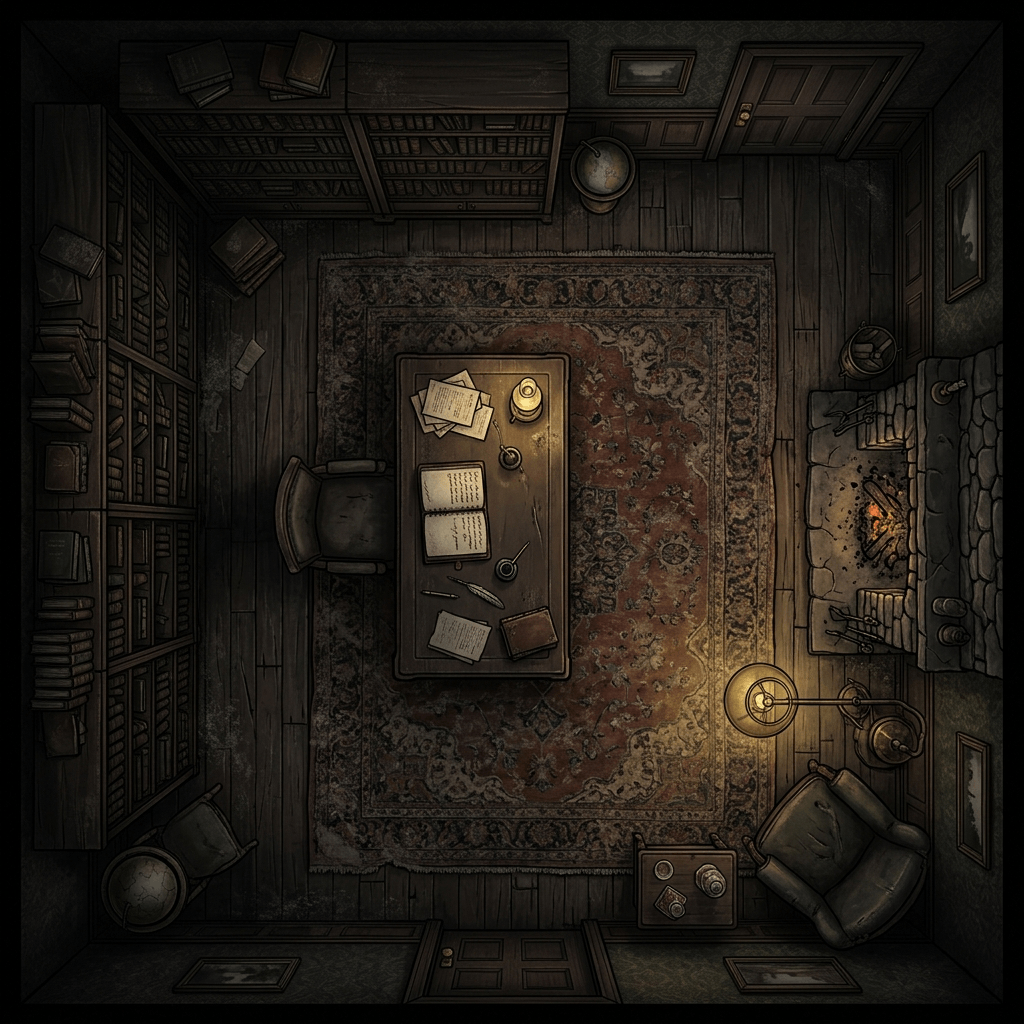
In horror tabletop roleplaying games, the visual environment plays a crucial role in establishing the mood. Unlike traditional heroic fantasy settings where maps depict epic battlefields and complex combat arenas, horror games rely heavily on atmosphere, mystery, and tension. When preparing a session for Chaosium's flagship game of cosmic dread, finding or designing a suitable Call of Cthulhu map can be a major challenge. Traditional fantasy asset libraries rarely contain 1920s furniture, rotary telephones, or Victorian bookcases. Fortunately, using modern AI tools, you can generate highly thematic investigation maps that build dread before the first dice are even rolled.
In this guide, we will explore why horror layouts require a different design philosophy than standard dungeon crawls. We will present six horror investigation prompts, explain how to prompt for different historical eras, and discuss how to use negative space to make your players feel truly uneasy.
Why a Call of Cthulhu Map is Built Differently
When you set up a horror rpg map, you must shift your focus from tactical combat spacing to narrative pacing and atmospheric tension. In most investigations, combat is rare, lethal, and brief. Therefore, your maps do not need to support complex movement loops or cover mechanics. Instead, they must serve three distinct purposes.
First, your layout must encourage slow, deliberate exploration. A typical investigation session involves characters searching an abandoned manor house, a municipal archive, or a local sanatorium. Your maps must feature logical architectural spaces, including hidden doors, small closets, and narrow staircases, that players can explore room by room.
Second, the visual design must prioritize mood over tactical utility. Instead of placing obstacles for combat cover, focus on elements that convey decay, isolation, and mystery. Heavy shadows, peeling wallpaper, dust-covered furniture, and dying fire embers on a cthulhu battle map immediately establish a sense of unease.
Third, focus on single-room scenes. A horror scenario rarely requires a massive multi-level dungeon layout. Often, the most intense moments occur in a single, confined space, such as a boarded-up study, a dusty library backroom, or a wet basement floor. Designing these smaller, highly detailed settings helps players focus on the immediate surroundings, making their search feel more claustrophobic. GMs can use the Text to Tabletop app to generate these highly detailed, single-room investigation spaces instantly.
Six Horror Investigation Map Prompts
To help you build these atmospheric environments, here are six ready-to-use prompts. These examples are optimized to work with a modern AI generator to produce a highly detailed investigation rpg map.
1. The Boarded-Up Mansion Study
A dusty, abandoned study where a missing professor conducted his final, sanity-shattering research.
- The Setup: A heavy wooden desk sits in the center, covered in scattered papers, ancient journals, and a rotary telephone. Sunlight filters through boarded windows, illuminating dust motes.
- The Prompt: "Top-down horror battle map of a dusty Victorian study, boarded windows with light rays filtering through, mahogany desk with scattered papers, bookshelves lining walls, leather chair, muted colors, gridless digital art."
2. The Asylum Hydrotherapy Wing
A cold, damp basement room in an asylum, containing rusted metal tubs and leather straps.
- The Setup: Rusted iron bathtubs line the tiled walls. A central drain in the concrete floor is stained, and the flickering light of a single bulb casts long, moving shadows.
- The Prompt: "Top-down map of an asylum hydrotherapy room, rusted metal bathtubs, tiled floor, central iron drain, wet concrete, single hanging lightbulb casting harsh shadows, cold blue color palette."
3. The Lighthouse Keeper's Quarters
A cramped, circular room at the top of a lonely lighthouse, surrounded by a raging sea storm.
- The Setup: A circular iron bed, a small desk with a brass lantern, and nautical charts scattered on the floor. Rain streaks are visible on the round glass windows.
- The Prompt: "Top-down circular lighthouse bedroom map, small iron bed, wooden desk with brass lantern, scattered papers, stone walls, dark night lighting, rain droplets visible on window panes, gridless."
4. The Occult Bookshop Backroom
A secret room hidden behind a heavy bookshelf, filled with forbidden texts and strange artifacts.
- The Setup: A small wooden table is covered in candles and open scrolls. Shelves are crammed with strange jars and ancient books.
- The Prompt: "Top-down occult bookshop backroom, stone floor, small round table with melting candles, shelves packed with ancient books and jars, shadows pooling in corners, warm flickering candle light."
5. The Foggy Coastal Cemetery
A damp, overgrown graveyard situated on a rocky cliff overlooking a dark, churning ocean.
- The Setup: Crumbling stone tombstones lean at odd angles in the thick grass, partially obscured by a heavy sea fog that rolls across the ground.
- The Prompt: "Top-down coastal cemetery battle map, crumbling stone tombstones, iron gate, dead trees, heavy white fog rolling over green grass, dark night lighting, gridless digital art."
6. The Cult Ritual Chamber Beneath the Church
A damp, subterranean brick cellar where an ancient occult order conducts their secret meetings.
- The Setup: A circular stone altar sits in the center, surrounded by wooden benches and glowing iron sconces. Symbolic carvings are visible on the stone floor.
- The Prompt: "Top-down brick cellar ritual room, central stone altar, circular carvings on stone floor, wooden benches, iron sconces with yellow flame, dark shadows, overhead perspective."
Setting Period vs Pulp vs Modern
Call of Cthulhu campaigns are typically set in three distinct eras: the gaslight Victorian era of the 1890s, the classic pulp era of the 1920s, or the modern day. When writing prompts, you can establish the period by specifying key technological and decorative elements.
For the 1890s, emphasize gas lamps, velvet upholstery, dark mahogany wood, and elaborate wallpaper patterns. For the 1920s, prompt for rotary phones, steam radiators, art deco patterns, and early electric light fixtures. For modern scenarios, mention plastic materials, computer monitors, fluorescent strip lighting, and modern office furniture.
Adjusting these details ensures your maps align perfectly with your campaign's setting. GMs can learn more about formatting these stylistic prompts in our guide on how to write the perfect AI map prompt.
What to Leave Off the Map
When generating a horror map, it is incredibly tempting to prompt for blood, corpses, or signs of struggle. However, we highly recommend leaving these elements off the canvas.
In horror, the most powerful tool is your players' imagination. Depicting a clean, empty room that feels subtly wrong is far more effective than showing a room covered in blood splinters. Let the physical environment convey that something is out of place, such as an open journal on a desk or a chair knocked over, and use your narrative descriptions to fill in the grim details.
Beyond Cthulhu: Other Horror Systems
While this guide focuses on Chaosium's classic system, these design philosophies apply to several other horror-adjacent tabletop RPGs. Grimdark dungeon crawlers benefit from similar high-contrast, atmospheric layouts. If you run a grimdark campaign, check out our guide on Shadowdark map inspiration to see how to build dread in dark fantasy settings.
Whether you are running space horror in Alien RPG, investigations in Liminal Horror, or psychological horror in KULT, the key is to prioritize atmosphere, shadow, and negative space over tactical grid lines.
To begin generating these atmospheric layouts instantly, use the Text to Tabletop app. The tool automatically enforces a flat top-down lock and strips out pre-baked grids, allowing you to build a custom Call of Cthulhu map in seconds on any device. Sign up at the Text to Tabletop app today and start building dread!
Tyler V
Lead Developer and UX Designer at Text to Tabletop. Passionate about helping GMs and players create better TTRPG experiences.
Ready to Forge Your Next Battle Map?
Describe the encounter and get a grid-aligned, top-down battle map in seconds, then regenerate any area until it matches your vision.
Generate Your First Map Free3 free map tokens · no credit card required