Curse of Strahd Battle Maps: Ten Years of Barovia, Mapped with AI
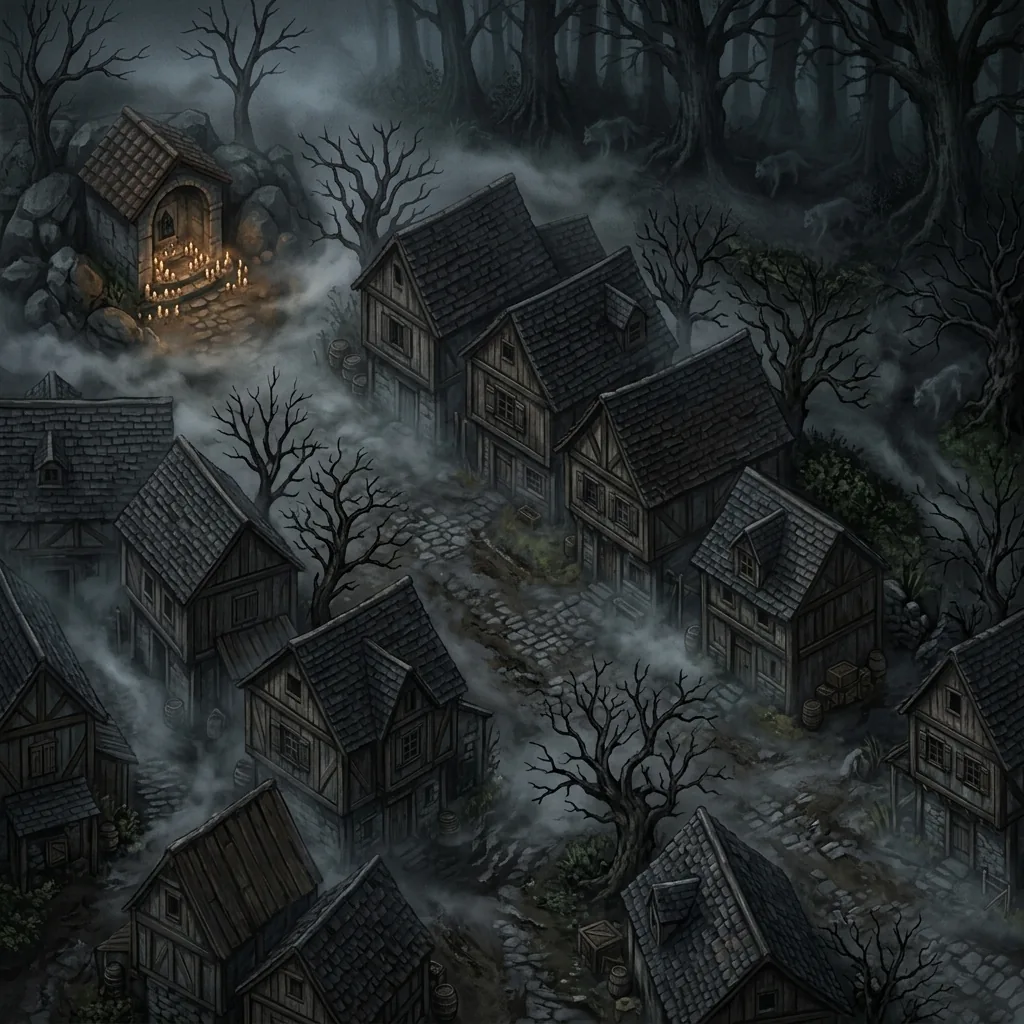
If you are searching for Curse of Strahd battle maps, you are prepping one of the most beloved campaigns Wizards of the Coast has ever published. The gothic-horror classic turns ten years old in 2026, and a full decade of tables has surfaced the same practical problem again and again: the famous locations get all the cartography, but most of the actual fighting in Barovia happens nowhere near them. Wolves hit the party on a muddy road. A cult stirs up trouble in a village street. A random encounter roll turns a quiet stretch of forest into a desperate melee, and the Game Master is suddenly improvising on a blank grid.
In this guide, we will share seven copy-paste AI prompts for the outdoor and incidental encounters Barovia throws at you, from the first broken gate in the mist to the drawbridge of the castle itself. We will also cover the two techniques that matter most for a long gothic campaign: locking a consistent oppressive look across every map you generate, and stretching a handful of generic road maps across dozens of encounters by regenerating small areas between sessions.
Why Barovia needs more maps than the book provides
Curse of Strahd is a travel campaign at heart. Its dread lives in the space between landmarks: fog-choked roads, gallows at lonely crossroads, and the constant feeling of being watched from the treeline. That is exactly where the random encounter checks land, and it is exactly where published cartography runs out. Sooner or later every group fights on "the road," and no book can key a map to a stretch of mud the dice invented five minutes ago.
There is also the palette problem. Barovia has one of the most recognizable looks in tabletop gaming: perpetual overcast, gray mist, muted colors, everything slightly dead. Drop a bright, sunlit forest map from a generic asset pack into the middle of that atmosphere and the mood shatters instantly. Every single map needs the gloom baked in, which is a hard ask for a stock library and an easy one for a text prompt. It is no accident that so many tables start this campaign in October; if you are running it as seasonal horror, our roundup of Halloween battle maps pairs naturally with everything below.
Seven Barovian encounter prompts
Each scene below is an original gothic location described generically, so you can drop it into whichever leg of the campaign needs it without worrying about matching any published layout. Copy the prompt, adjust a detail or two, and generate.
1. The broken gate on the forest road
The arrival moment: the mists part around a gate that no living guard has watched in years.
- The Setup: A rutted dirt road runs through a towering stone gateway, its iron gates rusted open. Cracked statuary flanks the pillars, and the fog behind the party looks thicker than the road ahead.
- The Prompt: "Top-down battle map of a muddy forest road passing through a ruined stone gateway, rusted iron gates hanging open, cracked statues beside the pillars, dense gray fog, skeletal pine trees, muted desaturated colors, gridless digital art."
2. The gloomy village main street
A village where every shutter is closed and the only sound is a creaking sign.
- The Setup: A mud street lined with sagging timber houses, a roadside shrine with guttering candles, and a stone well nobody seems to draw from. Perfect for a night ambush or a tense standoff with frightened locals.
- The Prompt: "Top-down battle map of a gloomy village main street, sagging timber houses with closed shutters, roadside shrine with melted candles, stone well, wagon ruts in thick mud, thin drifting fog, overcast gray light, gridless digital art."
3. The windmill on the crag
Every party eventually climbs toward the lonely windmill on the hill, and it rarely goes well for them.
- The Setup: A switchback path climbs a rocky crag to an old stone windmill with tattered sails. The open ground around the tower gives fliers every advantage and the party none.
- The Prompt: "Top-down battle map of an old stone windmill on a rocky crag, tattered sails, switchback dirt path, thorny scrub, raven shadows crossing the ground, bruised gray storm light, gridless digital art."
4. The festival square
A walled town that insists everything is fine, right up until the effigy catches fire.
- The Setup: A fortified town square dressed for a joyless festival: damp bunting, market stalls, and a burning wicker effigy on a central platform. Guards at the edges give a brawl here real consequences.
- The Prompt: "Top-down battle map of a fortified town square during a bleak festival, burning wicker effigy on a central wooden platform, damp bunting strung between lampposts, market stalls, rain-slick cobblestones, torchlight against gray drizzle, gridless digital art."
5. The fog-bound vineyard
The valley's last working vineyard, its far rows vanishing into white nothing.
- The Setup: Gnarled vines on wooden stakes form natural lanes of cover, while heavy fog cuts sightlines to a few rows in any direction. A superb map for a stalking horror the players can hear but not see.
- The Prompt: "Top-down battle map of a hillside vineyard in heavy fog, rows of gnarled grapevines on wooden stakes, low fieldstone walls, dirt cart track, scattered barrels, vine rows fading into white mist, muted greens and grays, gridless digital art."
6. The mountain pass
The road out of the valley climbs into the snow, and something has always held the high pass.
- The Setup: A narrow cliff-edge road squeezes past a crumbling guard tower. Rockfall and a sheer drop turn positioning into the whole fight.
- The Prompt: "Top-down battle map of a narrow mountain pass, cliff-edge road beside a sheer drop, crumbling stone guard tower, scattered rockfall, patches of snow, frayed rope and timber barricade, cold blue-gray light, gridless digital art."
7. The castle approach
Sooner or later the party walks the last stretch: a drawbridge over a black chasm, and the gate beyond it standing open.
- The Setup: Weathered planks span a chasm whose bottom the torchlight never finds. Gargoyles line the gatehouse, and every player at the table is quietly counting them.
- The Prompt: "Top-down battle map of a gothic castle drawbridge over a deep chasm, weathered wooden planks, portcullis gatehouse, gargoyle statues on stone plinths, swirling mist far below, storm lighting with a lightning flash, gridless digital art."
Keeping the Barovian look consistent across a campaign
A gothic campaign lives or dies on visual consistency. If session four's road map is crisp autumn sunshine and session five's is moody watercolor night, the valley stops feeling like one cursed place. The fix is simple: write your atmosphere modifier once and append it to every prompt for the entire campaign. Something like "dense gray fog, muted desaturated palette, overcast gloom" at the end of each description keeps twenty different maps reading as one unbroken stretch of the same haunted country. Keep the exact phrase in your prep notes and never improvise it.
This is also where a dedicated AI battle map generator earns its keep over general-purpose image tools. A strict 90-degree top-down perspective on every generation, with no pre-baked grids or stray character tokens, means each new map lands in the same visual register as the last, and your VTT grid overlays cleanly every time.
Reskinning road maps with area regeneration
Here is the quiet workhorse technique for a travel-heavy campaign: you do not need thirty road maps, you need three. Generate a few generic stretches of forest road and crossroads early on. Then, between sessions, select one region of a map and regenerate just that area with a new description. Swap the broken cart for a roadside gallows. Replace the shrine with a fresh grave. Add a snowdrift as winter closes in. The layout and lighting stay identical, so the map still matches your campaign look, but the players read it as a brand new stretch of road.
Area regeneration also lets a single location evolve with the story. The same village street can be generated once, then revisited later with one corner regenerated to show boarded doors and scorch marks. Nothing sells a darkening campaign like familiar ground getting worse.
Where to take the campaign next
If you are starting the campaign fresh this season, the famous haunted-house opening act is still the best on-ramp in all of published horror, and our Death House one-shot guide covers running it as a standalone Halloween special. And when your table finishes with the valley and wants more mist, the wider setting has domains to spare; our guide to Ravenloft battle maps is the natural next stop.
Ten years on, Barovia is still the campaign that teaches new Game Masters what atmosphere can do, and it deserves maps that carry their share of the dread. Generate the seven scenes above in minutes, lock in your fog modifier, and let the valley do the rest: sign up for the Text to Tabletop app today and start generating custom maps in seconds.
Tyler V
Lead Developer and UX Designer at Text to Tabletop. Passionate about helping GMs and players create better TTRPG experiences.
Ready to Forge Your Next Battle Map?
Describe the encounter and get a grid-aligned, top-down battle map in seconds, then regenerate any area until it matches your vision.
Generate Your First Map Free3 free map tokens · no credit card required