Text to Tabletop vs FantasyGen: Which AI Map Generator Fits Your Table?
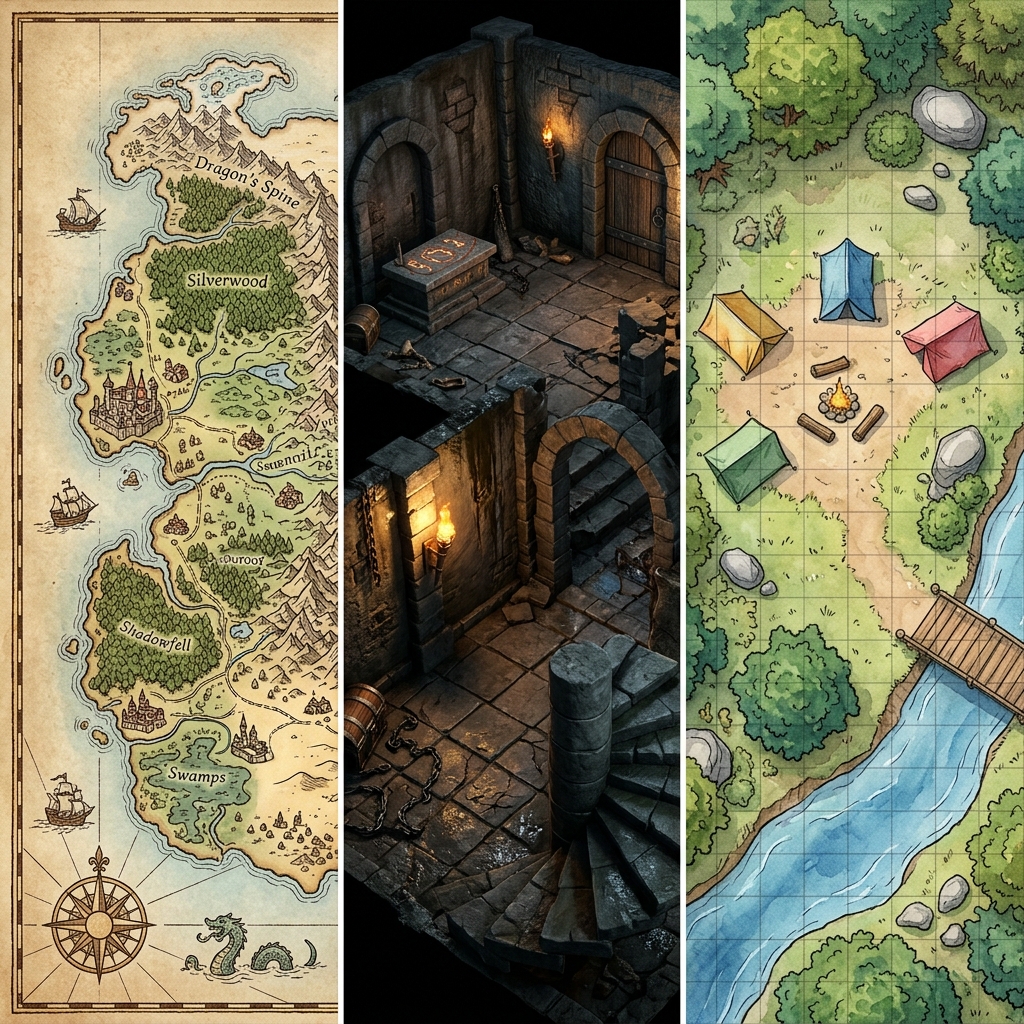
If you've been researching AI map generators for your tabletop game, you've probably run into both FantasyGen and Text to Tabletop. They look similar at first glance - both generate maps from text prompts, both offer credit-based pricing, both export images that work in Roll20 and Foundry VTT. But they're built around genuinely different philosophies, and which one fits you depends on how you actually prep your sessions.
Here's the honest version of that comparison, including the places where FantasyGen is the better choice.
The core difference: breadth vs depth
FantasyGen is an all-in-one worldbuilding platform. Alongside tactical battlemaps, it generates continent-scale world maps, regional parchment maps, city maps, character portraits, and concept art. If you're building a campaign setting from scratch - the kingdom map for your players' table, portraits for your NPCs, a mood piece for the capital city - you can do all of it in one tool with one pool of credits.
Text to Tabletop only makes battle maps. No world maps, no portraits, no concept art. Every design decision in the product - the strict 90-degree camera lock, the grid-cell dimension controls, the area-regeneration editor, the VTT export formats - exists to make the tactical combat map in front of your players as good and as usable as possible.
That's the trade in one sentence: FantasyGen covers your whole worldbuilding workflow at a shallower depth per map type; Text to Tabletop goes deeper on the one map type you use every single session.
Where FantasyGen wins
Honesty first. There are real reasons to pick FantasyGen:
- You need more than battle maps. If world maps and character portraits are a regular part of your prep, one subscription that covers everything is genuinely convenient.
- Raw price per generation. FantasyGen's larger credit packs work out cheaper per map than ours, and their credits never expire. If you generate in bulk and take the first result as-is, they're the budget option.
- Style variety. FantasyGen offers nine visual styles, including parchment and watercolor looks that mimic hand-drawn cartography. Text to Tabletop is tuned for a detailed, painterly top-down battle map aesthetic rather than a menu of art styles.
Where Text to Tabletop wins
1. You can fix a map instead of rerolling it
This is the big one. With most AI generators - FantasyGen included - your main lever when a map is 90% right is to regenerate the whole thing and hope. You lose the parts you loved along with the parts you didn't.
Text to Tabletop lets you select just the area you want to change - a room, a treeline, the left half of a courtyard - describe the change, and regenerate only that region. The rest of the map stays pixel-identical. You can also start from a blank grid and build a map section by section, which is closer to "drawing with prompts" than slot-machine generation. For maps you'll actually run combat on, this is the difference between a tool and a toy.
2. Grid-first generation
Battle maps live and die by grid alignment. Text to Tabletop asks for your map's cell dimensions (say, 20 x 15 at 5 ft per cell) before generating and composes the scene to those proportions, with no warped baked-in grid lines. The result snaps to Roll20's or Foundry's native grid without stretching, and you can export with or without a rendered grid overlay - or as a .dd2vtt file that carries the grid data into your VTT for you.
3. Cheaper high-resolution output
Both tools offer 1K, 2K, and 4K generation. FantasyGen charges 1/2/4 credits across those tiers; Text to Tabletop charges 1/2/3 tokens - so a 4K print-quality map costs 25% fewer credits here. If you print maps for in-person play, that difference compounds fast.
4. A trial that actually shows you the product
FantasyGen gives new users one free generation. Text to Tabletop gives you three free tokens - enough to generate a map, use the area editor to change something about it, and try a second concept. You get to test the feature that actually differentiates the tool before spending anything. No credit card required for either product, to be fair to both.
Pricing side by side
| Text to Tabletop | FantasyGen | |
|---|---|---|
| Free trial | 3 tokens on sign-up | 1 generation on sign-up |
| Entry pack | 10 tokens / $5 | 10 credits / $4.90 |
| Larger packs | 25/$10 - 60/$20 | 50/$6.90 - 150/$19.90 |
| Subscription | $10/mo - 50 tokens | $9.90/mo - 100 credits |
| 1K / 2K / 4K cost | 1 / 2 / 3 tokens | 1 / 2 / 4 credits |
| Area regeneration | Yes - select and edit any region | No - full regeneration |
| Commercial rights | Yes | Yes |
FantasyGen is cheaper per credit at pack scale. Text to Tabletop's counterargument is that you spend fewer tokens per finished map: when a generation is almost right, a one-token area edit rescues it instead of a fresh roll of the dice - and 4K costs less outright.
Which should you choose?
Choose FantasyGen if you want one tool for world maps, city maps, character portraits, and battlemaps, you generate maps in volume, and you're happy taking the best of several full generations.
Choose Text to Tabletop if battle maps are where your prep time actually goes, you care about grid alignment and VTT setup taking a minute instead of an evening, and you want to edit maps toward your vision instead of rerolling them.
The good news: with free trials on both sides, the real answer is to describe the same encounter to each tool and run the results at your own table. Your three free tokens are waiting - generate your first battle map and see how the area editor changes the way AI maps feel.
Tyler V
Lead Developer and UX Designer at Text to Tabletop. Passionate about helping GMs and players create better TTRPG experiences.
Ready to Forge Your Next Battle Map?
Describe the encounter and get a grid-aligned, top-down battle map in seconds, then regenerate any area until it matches your vision.
Generate Your First Map Free3 free map tokens · no credit card required