Best Tabletop RPG Map Generators in 2026: An Honest Comparison
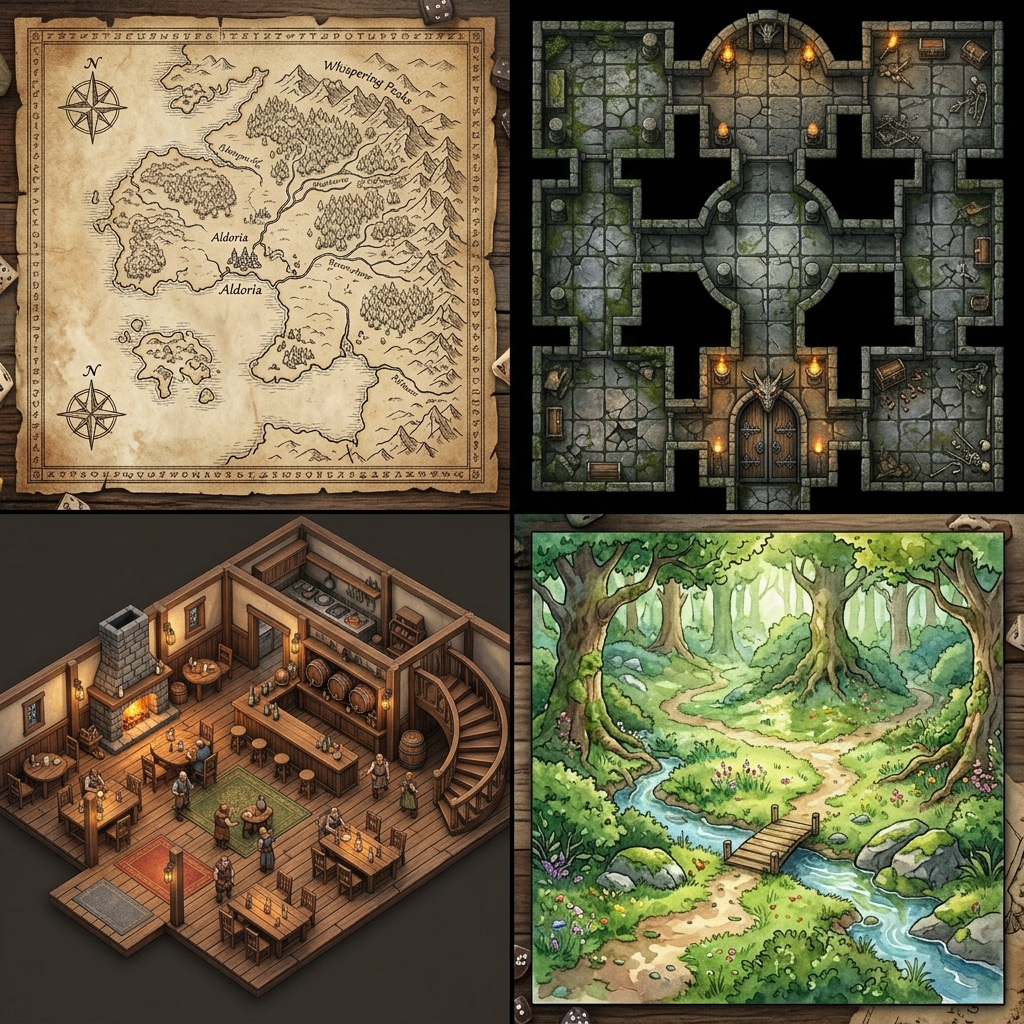
You stare at your campaign notes, realizing the party completely bypassed the heavily fortified mountain pass and is currently marching toward a bioluminescent swamp you have absolutely nothing prepared for. As a Game Master, your most precious resource is time, and scouring the internet for the perfect visual aid is a notorious time-sink. Finding a tabletop rpg map generator that fits your personal prep style can mean the difference between a stressed-out Saturday morning and a relaxed, confident session. Fortunately, the explosion of cartography tools means you are spoiled for choice.
How to Choose a Tabletop RPG Map Generator
Before diving into specific software, it helps to understand the landscape. In 2026, a tabletop rpg map generator generally falls into one of three distinct architectural categories, each serving a different type of Game Master.
Asset-placement tools require you to manually drop every single wall, floor tile, and wooden barrel onto a blank canvas. They offer total, uncompromising control over your encounter space, but they demand hours of your time and a decent eye for spatial design. Procedural 3D engines automate some of the heavy lifting by generating populated rooms based on the dimensions you draw, though they still require manual tweaking and rely heavily on rigid, pre-rendered asset libraries. Finally, generative AI tools build visuals entirely from natural language descriptions, drastically reducing prep time to seconds rather than hours, offering infinite stylistic flexibility.
If you want a deeper look at how these philosophies clash and complement each other, check out our comprehensive breakdown of AI vs. asset-placement vs. procedural generation. Ultimately, finding the best battle map generator for your campaign depends entirely on how much free time you have during the week and how granular you need your spatial control to be.
The Top 7 Tabletop RPG Map Generators in 2026
Let us take a look at the current titans of the cartography scene, breaking down their strengths, weaknesses, and ideal use cases to help you streamline your session prep.
1. Text to Tabletop
When your players decide to kick in the door of a random tavern and you have absolutely nothing prepared, Text to Tabletop is your immediate savior. Built specifically as a generative tabletop rpg map generator, it allows you to type out exactly what you need and instantly receive a highly detailed, playable battle map. You can try it right now.
The real magic here is in the specialized pipeline: the tool enforces an automatic 90-degree top-down lock, ensuring the perspective is always perfect for virtual tabletops. Furthermore, it automatically strips out unwanted grids and accidental NPC generation so you are left with pure, usable terrain. Learning to write the perfect map prompt takes just a few minutes, and the payoff is unprecedented speed. Operating on a subscription model, it is the ideal tool for GMs who value speed, flexibility, and limitless aesthetic styles over pixel-level asset placement.
2. Inkarnate
Inkarnate remains a beloved staple in the tabletop RPG community, particularly renowned for its regional and world map capabilities. It operates as a web-based, asset-placement ttrpg map maker, offering gorgeous, hand-painted stamps that give continents and sprawling cities a distinct, cohesive fantasy aesthetic. You paint terrain textures, stamp down mountain ranges, and place city icons to build vast empires.
While it certainly offers battle map creation tools, placing individual tables, chairs, and flagstones can become tedious compared to faster alternatives. It utilizes a freemium model, with a subscription required to access the highest-resolution exports and massive commercial asset libraries. Inkarnate is best suited for dedicated world-builders mapping out their grand Pathfinder or Shadowdark realms over the course of a long weekend.
3. Dungeon Alchemist
Dungeon Alchemist sits firmly in the procedural 3D category of mapping software. You draw the dimensions of a room, select a theme like "abandoned tavern" or "vampire crypt," and the software automatically populates the space with tables, dynamic lighting, and cobwebs.
Its strongest feature is its direct export integration for major virtual tabletops, automatically carrying over wall boundaries and lighting data for dynamic line-of-sight mechanics. However, because it relies heavily on 3D assets, you are constrained to the specific styles and themes available in its core library or what you can scrounge up on the Steam Workshop. Available as a one-time desktop purchase, this software is perfect for GMs who run virtual sessions and heavily utilize dynamic lighting mechanics, provided they have the time to sculpt the initial room dimensions.
4. Dungeondraft
If you demand total, uncompromising control over every single square inch of your encounter space, Dungeondraft is arguably the asset-placement king. It features a clean, comic-book-inspired aesthetic by default and uses a smart wall and cave-generation system that speeds up the drafting process slightly.
Because you are placing everything by hand, generating a massive, multi-level fortress takes a significant time investment. However, its community support is unmatched, allowing you to import massive custom asset packs for science fiction, cyberpunk, or horror settings like Call of Cthulhu. Sold as a one-time desktop purchase, Dungeondraft is the best battle map generator for meticulous GMs who genuinely enjoy the meditative process of building their dungeons brick by brick.
5. Wonderdraft
Created by the same independent developer as Dungeondraft, Wonderdraft is focused entirely on macro-scale cartography. It excels at producing gorgeous, Tolkien-esque, parchment-style regional and world maps. Its tools for generating realistic coastlines, painting rivers that naturally branch toward the sea, and clustering mountain ranges are incredibly satisfying and intuitive to use.
It is absolutely not designed to be a battle map generator; you will not use this software to map out a narrow alleyway ambush. Available for a one-time desktop fee, Wonderdraft is the premium choice for Game Masters creating immersive campaign handouts, establishing political boundaries, and plotting out massive hex-crawl campaigns where the journey is just as important as the destination.
6. Watabou
Sometimes you just need a highly functional layout without any financial commitment or learning curve. Watabou's suite of procedural generators, most notably the Medieval Fantasy City Generator and the One Page Dungeon generator, are entirely free and run instantly in your web browser.
With a single click, Watabou spits out a fully mapped city complete with named districts, defensive walls, and rivers, or a sprawling, twisting dungeon complete with basic room descriptions. The visual output is highly stylized, usually resembling a stark black-and-white blueprint or a minimalist architectural sketch. It lacks the lush, full-color visuals required for a highly immersive modern virtual tabletop experience, but as a pure, instantaneous structural tool, it is an invaluable bookmark for any Game Master on a tight budget. For a full head-to-head, read our comparison of Watabou vs AI battle maps.
7. Czepeku
While technically not a software-based tabletop rpg map generator, no discussion of tabletop cartography is complete without mentioning Czepeku. They are a prominent duo of artists creating hand-drawn, breathtakingly beautiful pre-made encounter maps.
Subscribing to their Patreon gives you access to thousands of variations of their art, covering everything from arcane libraries to soaring airships and infernal engine rooms. The drawback, naturally, is narrative rigidity. You are completely at the mercy of whatever they have already drawn; if your specific narrative requires a layout that does not exist in their vast archive, you have to adjust your story to fit the art. They remain the ideal solution for GMs who prefer to build their encounters around existing, high-quality artwork rather than creating custom maps from scratch to fit an established narrative.
Which Tabletop RPG Map Generator Is Right for You?
Choosing the right tool ultimately comes down to identifying your primary prep constraint: time, artistic control, or budget. If you want a weekend project to carefully place every silver goblet on a noble's dining table, an asset placer like Dungeondraft is your absolute best bet. If you need dynamic lighting barriers automatically drawn for your virtual tabletop and you do not mind slightly rigid 3D assets, Dungeon Alchemist is superb.
If you are building out massive, sprawling continents for a homebrew fifth edition compatible setting, load up Inkarnate or Wonderdraft. But if your session starts in exactly twenty minutes, your players just derailed the plot, and you desperately need a custom, high-quality visual tailored to your exact scene, a generative AI solution is unparalleled. And if budget is your binding constraint, our roundup of the best free AI map generators covers the zero-cost end of the spectrum.
The Speed Argument
Let us be brutally honest about Game Master prep: the narrative and the pacing should always come first. Every hour you spend fussing with wall nodes, adjusting the shadow opacity on a digitally painted tree, or hunting through disorganized asset folders for the right cobblestone texture is an hour you could have spent developing compelling villains, designing intricate puzzles, or weaving player backstories into the lore of the world.
The primary advantage of using a generative tabletop rpg map generator is the immediate reclamation of your prep time. By offloading the visual heavy lifting entirely, you ensure that your encounters are always supported by gorgeous, immersive art, without sacrificing the structural and narrative preparation that actually makes a session memorable for your players. You get to focus your mental energy on running an amazing game, rather than stressing over drawing the board.
Ready to stop dragging and dropping and start playing? Text to Tabletop gives you the power to conjure any encounter space you can imagine with just a few descriptive words. With our automated 90-degree top-down perspectives and clean, grid-free outputs, your weekly prep time is about to shrink from hours to seconds. Head over to Text to Tabletop to create your first map today and finally take back your Saturday mornings.
Tyler V
Lead Developer and UX Designer at Text to Tabletop. Passionate about helping GMs and players create better TTRPG experiences.
Ready to Forge Your Next Battle Map?
Describe the encounter and get a grid-aligned, top-down battle map in seconds — then regenerate any area until it matches your vision.
Generate Your First Map Free3 free map tokens · no credit card required